
Reviewed · PRAGUE COMMUNISM HISTORY TOURS
Communism and its fall Prague private tour
Prague’s communist past comes into sharp focus on this private walk, especially when your guide is Jana Neubergova, who took part in the Velvet Revolution and later worked in Václav Havel’s office. This is not just a parade of monuments. It connects familiar streets with the demonstrations, debates, and public gatherings that changed Czechoslovakia.
I like the small private format, which lets you ask direct questions and spend more time on the parts that matter to you. I also like the personal link to 1989. Jana can add memories from the demonstrations rather than offering only dates and political labels. The main drawback is that two hours passes quickly, and the tour is entirely on foot, with no private transport included.
Key points at a glance
- Jana Neubergova’s first-hand perspective: She participated in the Velvet Revolution and later worked in Václav Havel’s office.
- A focused route through central Prague: The National Theatre, Národní Street, Lucerna Arcade, Wenceslas Square, and the Memorial to the Victims of Communism all fit into roughly two hours.
- A private experience in English: Only your group takes part, so the pace and questions can be more personal.
- Strongest for modern Czech history: The tour centers on communist rule, the November 1989 demonstrations, and the fall of the regime.
- Simple walking logistics: Pickup on foot is offered from all Prague hotels, but private transportation is not included.
- Good cancellation flexibility: You can cancel up to 24 hours before the start for a full refund.
Prague’s 1989 story begins on foot
This tour is best understood as a walk through places where public life and politics met. You move from the National Theatre to Národní Street, then through Lucerna Arcade and across Wenceslas Square before finishing at a memorial to people harmed by communist rule.
The route is compact, but the subject is not. You are not simply looking at buildings. You are following the setting for public demonstrations, cultural activity, political change, and remembrance.
The private setup matters here. Communist history can raise personal and political questions, and a private guide gives you room to stop and ask them. You are not trying to squeeze your questions into a large group or keep pace with strangers. If one site catches your attention, you can ask Jana to explain its role in the wider story.
The tour is offered in English and lasts about two hours. That makes it easy to fit into a Prague stay, though you should expect a brisk route with several short stops rather than a long indoor visit at any one location.
More communism history tours in Prague:
- Prague: Communism History and Nuclear Bunker Guided Tour
★ 4.7 · 2,417 reviews - Prague Communism History and Nuclear Bunker Tour
★ 5.0 · 1,742 reviews - Communism & Nuclear Bunker Tour + 70s Canteen Lunch (own expense)
★ 5.0 · 1,036 reviews
Starting at the meeting point of Czech intellectuals
The walk begins at a meeting point associated with Czech intellectuals. The supplied details do not give the exact name of this opening location, so confirm the precise meeting place when you book.
This opening sets the right tone. The tour is concerned not only with government and protest, but also with the people who shaped ideas, culture, and public debate. That distinction helps explain why the National Theatre and Lucerna Arcade belong on a tour about communism and its fall.
Because this is a private walk, you can ask Jana to clarify how the cultural and political sides of the story connect. Her background gives this opening extra weight. She participated in the November 1989 demonstrations and later worked for Václav Havel, one of the central figures in the transition after communism.
The National Theatre and the power of culture
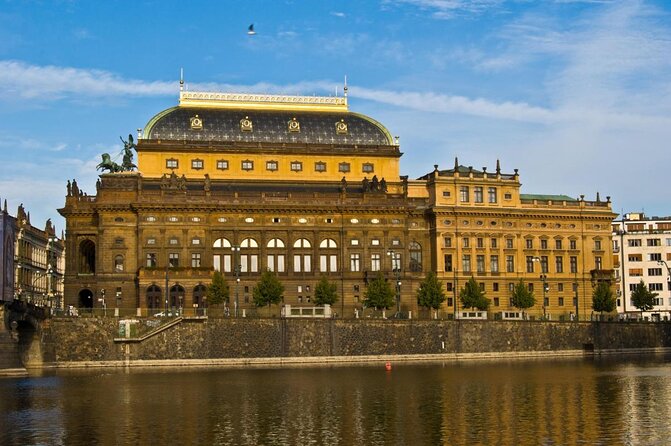
The first listed stop is the National Theatre, with about 10 minutes set aside for the visit. You do not need an admission ticket for this tour stop, but admission is not included if you want to enter on your own.
The theatre played an important role in Czech history, and its place on this route shows how culture can become part of national and political life. Here, Jana can help you see the building as more than a grand Prague landmark. It belongs to the story of Czech identity and public expression.
Ten minutes is enough for an exterior explanation and a short look around. It is not enough for a full theatre visit, so keep your expectations clear. If you want to see a performance or spend time inside, that would require separate planning.
I like this stop because it broadens the tour beyond political monuments. It reminds you that the fall of communism was also connected with artists, writers, performers, and public voices. The tour does not treat history as something confined to government offices.
Národní Street, where the Velvet Revolution began
The tour then spends about 15 minutes on Národní Street, identified as the place where the Velvet Revolution started. This is one of the most important stops for understanding the events of November 1989.
Here the subject becomes immediate. You are standing in the city center, on a real street connected with the beginning of the movement that led to the end of communist rule in Czechoslovakia. Jana’s own participation in the demonstrations gives this section particular value.
Her personal memories are the reason I would choose this private tour over a basic historical overview. A guide who was present can explain the events in human terms, not just list them as a turning point in a textbook. You can ask what the demonstrations felt like, how people responded, and how the mood changed.
The published stop time is short, so you may want to decide in advance what interests you most. If your main reason for booking is the Velvet Revolution, tell Jana that at the start. The private format should make it easier to focus on 1989 rather than giving equal time to every stop.
A few more Prague outings worth weighing up
- Prague Old Town: Private Tour
★ 5.0 · 1,223 reviews - Prague Airport Private Arrival Transfer
★ 4.5 · 991 reviews - Prague Airport Private Departure Transfer
★ 4.5 · 780 reviews - Discover Prague Private Tour – 3 hours
★ 5.0 · 705 reviews
Lucerna Arcade and the Havel family connection
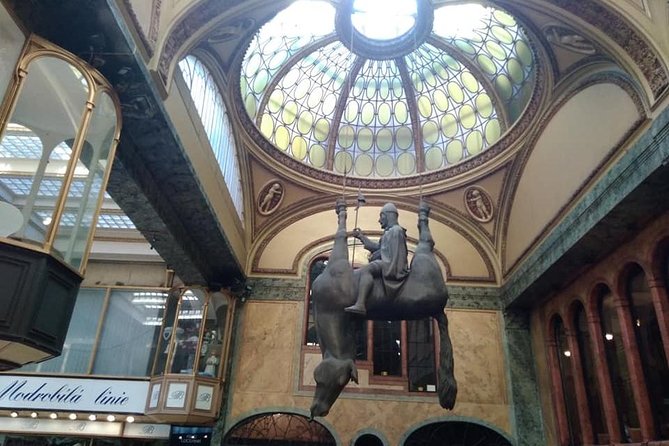
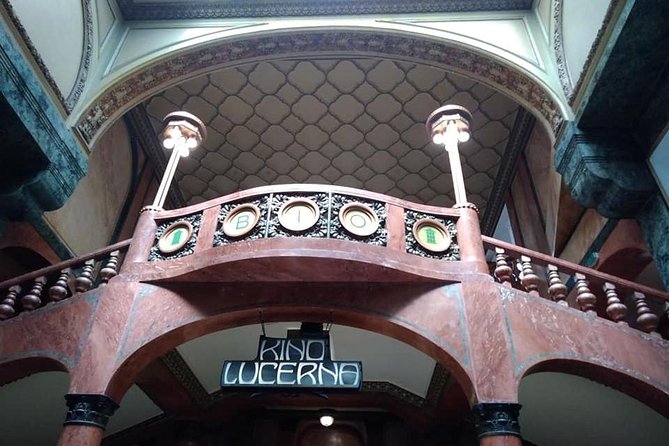
Lucerna Arcade receives about 10 minutes. This important cultural and social center was founded by Václav Havel’s family, giving the stop a direct connection to one of the most recognizable figures in modern Czech history.
The arcade adds a different kind of setting to the walk. Unlike a monument built to commemorate a single event, it represents a place where culture and social life developed. That makes it useful for understanding the public world around Czech political change.
The Havel connection is also more personal because Jana later worked in Havel’s office. You can ask her about that period and about Havel’s role after the fall of communism. The supplied information does not specify her exact job or the length of time she worked there, so ask her directly rather than expecting a detailed professional biography.
Lucerna Arcade is a brief stop, but it may be one of the most distinctive parts of the route. It links an everyday Prague setting with both the Havel family and the broader story of cultural life under communism.
Wenceslas Monument in the heart of Prague
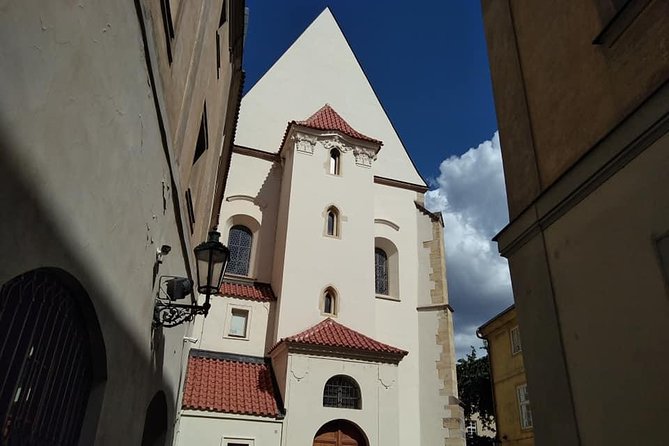
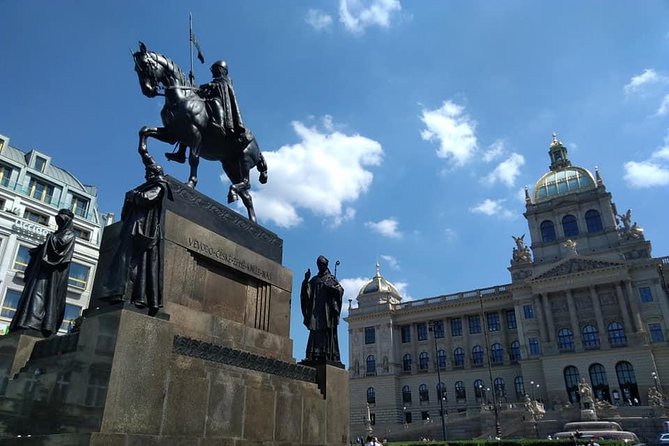
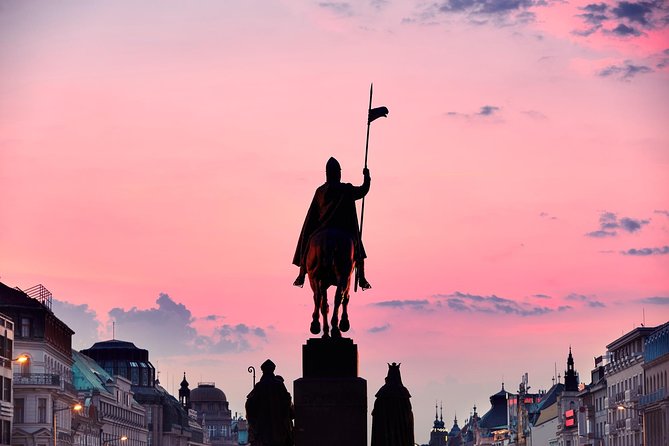
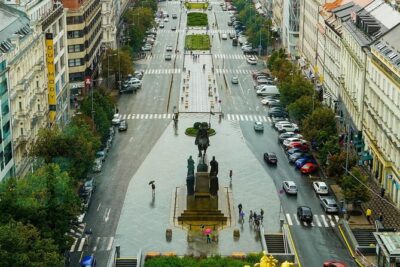
The longest stop is at the Wenceslas Monument, with about 20 minutes at Wenceslas Square. The monument honors the Czech patron saint and sits in what is described as the very heart of Prague.
This is also the place where demonstrations are still held. That makes the square a natural stage for the tour’s political story. You can look at the monument, consider the scale of the square, and hear how this central space has been used for public gatherings.
The longer stop gives Jana more room to place the Velvet Revolution in the setting of Prague’s civic life. It also gives you time to ask questions about why this square matters and how public demonstrations connect the separate parts of the tour.
Wenceslas Square is a busy central location, so do not expect a quiet museum-like atmosphere. The advantage is that you are seeing a working public space rather than a sealed historical display. The disadvantage is that street activity may make it harder to hear at certain moments. Stay close to your guide and speak up if you miss a point.
Remembering victims at the final memorial
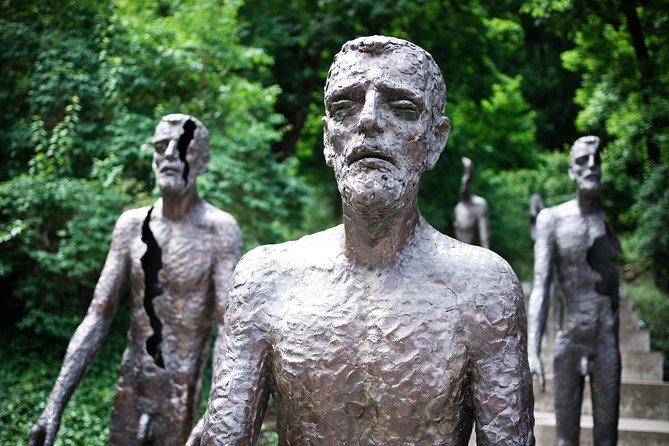
The walk ends at the Memorial to the Victims of Communism. About 15 minutes is planned here, and admission is free.
The memorial was created by sculptor Olbram Zoubek, one of the most notable Czech artists. Its purpose is to commemorate people who suffered under communist rule, giving the tour a sober closing point after the focus on demonstrations and political change.
This stop keeps the tour from becoming a simple celebration of 1989. The end of communism mattered, but the memorial asks you to remember the human cost of the period that came before it. That balance is important, especially if you know little about the subject.
Allow yourself a quiet moment here. The tour includes many connections and names in a short time, and this final stop gives you a chance to think about what those changes meant for ordinary people. It is a fitting place to finish a tour about both political transformation and memory.
Why Jana’s personal experience changes the tour
The strongest reason to book this walk is Jana herself. She is described as a fully licensed professional guide who speaks English very well, and her background is unusually close to the subject.
She participated in the demonstrations against communism in November 1989. She also worked in Václav Havel’s office soon afterward. Those details do not make the tour a substitute for a history book, but they can add the kind of personal detail that a standard city walk cannot provide.
I would ask Jana about the moments she remembers most clearly, what changed after the demonstrations, and how Prague felt during the transition. Since this is a private experience, you can shape the conversation around your own level of interest.
You should also keep the limits in mind. First-hand experience is valuable, but the tour remains about two hours long. It cannot cover every part of communist Czechoslovakia, the full political background, or every consequence of the transition. Think of it as a focused introduction with a rare personal connection.
What $85 means in practical value
At $85 per person, the price is easiest to justify if you value a private guide and a personal account of the Velvet Revolution. You are paying for a focused walk, a licensed guide, and the chance to ask questions without a larger group controlling the pace.
The value is less obvious if you only want to see Prague’s main sights from the outside. Several stops are short, and no admission tickets are included. The National Theatre and Lucerna Arcade each receive about 10 minutes, while Národní Street gets about 15 minutes. The memorial is free, and the Wenceslas Monument is an outdoor stop.
You also do not receive private transportation. Pickup is offered on foot from all Prague hotels, so clarify how the meeting will work for your accommodation. Since the route is walking-based, wear comfortable shoes and expect to stay on your feet for most of the two hours.
A free map of Prague is included. That is a small benefit, but a useful one if you are still learning the city center and want to continue exploring after the tour.
Who will get the most from this walk
I would recommend this tour most strongly to you if:
- You want a clear introduction to communist Prague and the Velvet Revolution.
- You prefer a private guide to a large group.
- You enjoy modern political and social history.
- You value first-hand memories and personal stories.
- You want to ask detailed questions in English.
- You have moderate physical fitness and are comfortable walking between central sites.
It is also a good choice for people who have already seen Prague Castle, Charles Bridge, and the Old Town but want a different side of the city. This route shifts attention from medieval and imperial Prague to the events of the 20th century.
You may want a different experience if you need wheelchair-specific information, a vehicle between stops, or long interior visits. The available details say that service animals are allowed and that the route is near public transportation, but they do not provide a full accessibility description. Ask the provider before booking if you have mobility concerns.
Timing, pickup, and cancellation advice
The tour is offered Monday through Sunday from 9:00 a.m. to 6:00 p.m. during the published operating period of July 11, 2023 through March 23, 2027. Confirm your preferred time when booking, especially if you want to fit the walk around other Prague plans.
On-foot pickup is offered from all Prague hotels. Since private transportation is not included, expect the experience to begin as a walking tour rather than a vehicle-based excursion.
Confirmation normally arrives at booking. If you book within one day of the tour, confirmation comes as soon as possible and depends on availability.
You can cancel for a full refund up to 24 hours before the start time. Changes or cancellations made less than 24 hours before the start are not accepted for a refund. The cut-off uses Prague local time, so keep that in mind if you are booking from another time zone.
Should you book Communism and its Fall Prague?
Book it if you want Prague history told through real places and a guide with a direct connection to 1989. Jana’s participation in the Velvet Revolution and later work in Havel’s office give this short walk a personal quality that is hard to reproduce with a standard sightseeing route.
The tour is especially good early in your Prague visit, when it can help you understand the city’s modern political story before you explore more on your own. At $85 per person, it is a fair choice for a private experience, but less compelling if you want extensive indoor sightseeing or transportation.
My practical advice is to book this for the guide and the conversation, not for the number of sights. If you are willing to walk, ask questions, and give modern Czech history your attention, this compact route can add real meaning to the streets you see afterward.
FAQ
How long does the Communism and its Fall Prague tour last?
The tour lasts approximately two hours.
Is this a private tour?
Yes. Only your group participates in the activity.
Is the tour offered in English?
Yes. The tour is offered in English.
Does the tour include hotel pickup?
On-foot pickup is offered from all Prague hotels.
Is private transportation included?
No. Private transportation is not included.
Which places does the tour visit?
The route includes the meeting point of Czech intellectuals, the National Theatre, Národní Street, Lucerna Arcade, the Wenceslas Monument, and the Memorial to the Victims of Communism.
Can I cancel for a full refund?
Yes. You can cancel at least 24 hours before the experience start time for a full refund. Cancellations or changes made less than 24 hours before the start are not accepted for a refund.
Just added around Prague
- Prague: Historical Walking Tour with Focus on World War 2★ 4.3 · 12 reviews
- WWII and Communism History in Prague’s Old Town Private Tour★ 5.0 · 4 reviews
- World War II 4WD Tour from Prague with Lunch★ 4.4 · 3 reviews
- Unique salt cave in Prague★ 4.9 · 10 reviews
- Walking tour of Prague in French : Nové Město★ 4.9 · 16 reviews
- Walking tour of Prague in french: Old Town & Charles Bridge★ 4.9 · 62 reviews
- Ultimate Unlimited Beer Pong with Czech Beer★ 4.6 · 5 reviews
- Prague: Market Tour and Traditional Czech Cooking Class★ 4.7 · 19 reviews
Prague Communism History Tours, compared.
Communism History and Nuclear Bunker Guided Tour
Read our review →
Prague Communism History and Nuclear Bunker Tour
Read our review →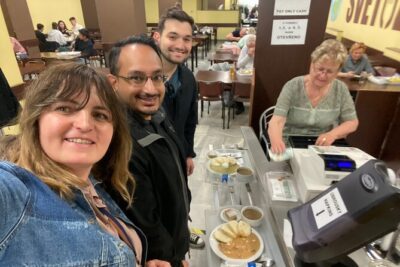
Communism & Nuclear Bunker Tour + 70s Canteen Lunch (own expense)
Read our review →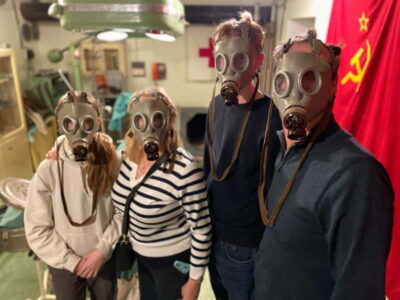
Communism and Bunker Tour with 70s Canteen Lunch
Read our review →
Second World War & Communism (Tip-based 3 hour tour)
Read our review →Browse the lists this tour appears in