
Reviewed · HISTORICAL TOURS
Prague Literary & Historical Tours – Literature Route
Prague’s literary past is not confined to museums. It is tucked into pubs, river islands, old streets, and public squares. This two-hour route with guide Fergus uses five locations to connect writers, political change, scandal, and daily city life, moving from modern Prague back toward the early twentieth century.
I like the route’s small-scale storytelling and its unusual stops, especially U Zlatého tygra and Slovanský ostrov, places you could easily pass without knowing their literary importance. I also like that Fergus links writers such as Hrabal, Kafka, and Kundera to social and political events instead of treating literature as a list of names.
The main consideration is its subject. If you want grand interiors, famous monuments, or a traditional sightseeing circuit, this may feel too specialized. The tour is also delivered in English and lasts about two hours, so you should be ready to listen closely while walking between stops.
Key points about Prague’s Literature Route
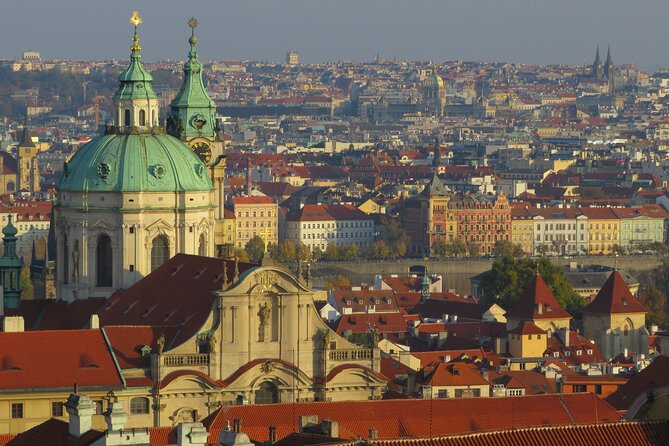
- Five stops connect literature to everyday Prague, including a historic pub, river island, side street, and large urban square.
- Guide Fergus brings together Kafka, Kundera, Hrabal, and Prague’s avant garde in one chronological story.
- The route moves backward through time, beginning with more recent literary figures and ending near writers of the nineteenth century.
- All listed stops have free admission, so the $21.66 price pays for the guiding rather than entry tickets.
- The tour ends at Charles Square, near the New Town Hall and river promenades, making it easy to continue exploring.
- The group can include up to 25 people, a size that keeps the price modest but may feel less intimate than a private walk.
Why Prague makes such a good literary city
Prague rewards anyone who likes cities with more than one story at a time. Czech, German, and other cultural influences have crossed here for centuries, and the route uses that mixture to explain why Prague’s writers often wrote about identity, power, belonging, and uneasy social change.
That is the useful difference between this tour and a simple author-spotting walk. You are not just told that a writer lived nearby. You are shown how the city’s changing politics, languages, social divisions, and artistic movements shaped the way people wrote.
The route begins in the Old Town and gradually leaves the busiest streets behind. As the walk progresses, the subject moves backward through time. That structure gives the experience a clear plot, much like reading a short book in reverse order.
Fergus is the guide named in the tour details, and the strongest praise centers on his ability to connect facts into a story. He covers literature, history, social conditions, and personal anecdotes without making the route feel like a classroom lecture. That balance matters here because the subject could easily become a string of unfamiliar names.
You do not need to arrive as a Prague literary expert. The walk is designed to provide background as it goes. At the same time, readers already familiar with Hrabal, Kafka, Kundera, or Czech literary movements should find enough context to add new layers to places they may already know.
More history tours in Prague:
- Prague: Oldtown, Medieval Underground & Dungeon History Tour
★ 4.2 · 8,244 reviews - Prague Old Town, Medieval Underground and Dungeon Historical Tour
★ 4.5 · 3,227 reviews - Prague: Communism History and Nuclear Bunker Guided Tour
★ 4.7 · 2,417 reviews
U Zlatého tygra: begin with Prague’s literary present
The first stop is U Zlatého tygra, where the tour opens with a look at Czech literature and the people connected with this well-known Prague pub. You spend about 20 minutes here, with no admission ticket required.
The pub gives the route an immediate sense of place. Instead of starting with a statue or formal memorial, you begin in a setting tied to conversation, writers, and ordinary city life. That choice helps establish the tour’s central idea: Prague’s literary world developed in real rooms and streets, not only in bookshelves.
This is also where Fergus begins setting up the larger story. The tour starts with more recent material and then moves gradually into earlier periods. You can expect the opening chapter to focus on people and events that make the city’s literary past feel close to present-day Prague.
The practical limitation is simple: a pub stop does not mean you should assume a meal or drink is included. The information provided lists an admission ticket as free, but it does not promise food, beverages, or an indoor seated session. Think of U Zlatého tygra as a storytelling location rather than a scheduled pub visit.
Bartolomějská: a stop built around surprise
The second stop is on Bartolomějská, another 20-minute chapter in the walk. The precise subject is intentionally not given in advance, so this is the part of the route that depends most on Fergus’s presentation.
That can work well if you enjoy discovering a place through its stories rather than arriving with every fact printed out. The street is also a useful change of pace after the better-known Old Town setting. The route begins to move away from the busiest sightseeing areas, and the subject becomes less predictable.
You should not expect a long list of standard Prague highlights here. The value is in the explanation of what happened in this corner of the city and why it matters to literature or history. The route’s promise is not a grand view at every stop. It is a new way of reading streets you might otherwise overlook.
Because the details of this stop are not disclosed, I would not choose this tour if you need a tightly itemized itinerary before booking. The mystery is part of the appeal, but it also means the experience depends heavily on your interest in the guide’s chosen story.
Slovanský ostrov: Prague’s interwar avant garde
The longest stop comes at Slovanský ostrov, also known as Žofín. You spend about 40 minutes here learning about personalities from Prague’s interwar avant garde.
This is likely the intellectual center of the route. The interwar period offers a particularly useful window into Prague because it brings together art, politics, changing national identities, and new ideas about modern life. The island setting gives the group room to pause and consider that period rather than racing through another quick address.
The stop is valuable for readers who want more than the familiar Kafka story. The tour includes writers and movements linked to wider Czech culture, including Bohumil Hrabal and Milan Kundera in the larger discussion. Fergus also places literary movements beside historical and economic change, which helps explain why authors wrote as they did.
The 40-minute timing tells you something about the tour’s priorities. This is not a quick photo stop. It is the place where you should expect the most sustained explanation and discussion. If you prefer short bursts of sightseeing, it may feel long. If you enjoy ideas, personalities, and connections between art and society, it may be the strongest section.
No admission fee is listed for the island stop. The route’s appeal here comes from the setting and the interpretation, not from entering a paid attraction.
Same city, a completely different afternoon:
- Prague: 50-Minute Sightseeing Evening Cruise
★ 4.2 · 33,780 reviews - Prague: Medieval Dinner with Unlimited Drinks
★ 4.4 · 19,847 reviews - Prague: Skip-the-line Castle Ticket and Optional AudioGuide
★ 4.3 · 11,121 reviews - Prague: Castle Tour with Local Guide and Entry Ticket
★ 4.6 · 10,422 reviews
Pštrossova: literature in a city of many identities
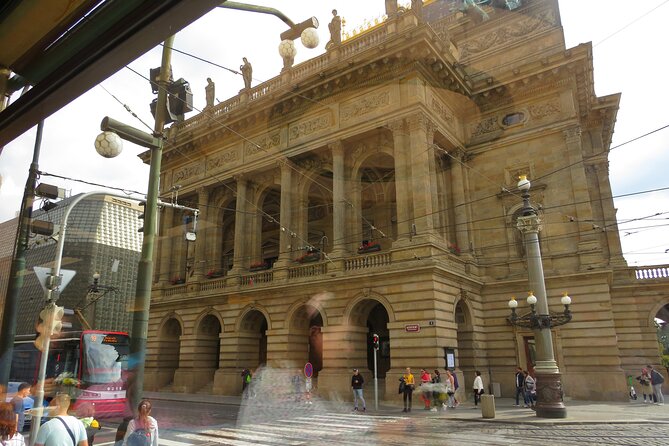
At Pštrossova, the tour reaches the beginning of the twentieth century and the birth of the First Republic. This 20-minute stop focuses on a Prague where multiple ethnicities lived and competed for space, influence, and identity.
That context is essential. Prague’s literary past cannot be explained through one national story alone. Writers worked in a city shaped by several languages and communities, and the tension between those groups affected public life as well as literature.
I find this kind of stop especially useful because it gives you a framework for the authors discussed elsewhere. Names such as Kafka become easier to place when you understand the city’s overlapping cultures and political pressures. The tour does not treat writers as isolated geniuses. It presents them as people working inside a complicated urban society.
Pštrossova also helps the route maintain its backward movement through time. By now, you are no longer looking only at individual writers. You are seeing how Prague itself changed around them.
The drawback is that a 20-minute stop can only introduce a period rather than explain every part of it. You may leave with new questions, which is a good result, but you should not expect a full university course on the First Republic.
Charles Square: finishing among nineteenth-century writers
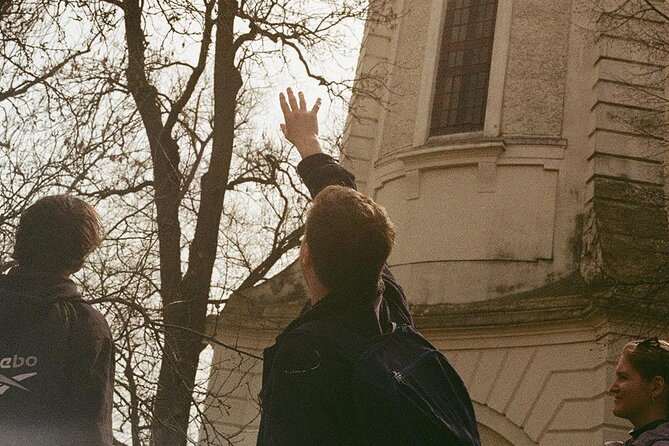
The final stop is Karlovo náměstí, or Charles Square, where the tour ends after about 20 minutes. Important nineteenth-century writers lived near the square, and the open urban setting provides a fitting close to the route’s backward journey.
Charles Square is a practical ending point as well as a historical one. The tour finishes near the New Town Hall and river promenades, so you can continue walking, find a place to eat, or explore another part of Prague without returning to the starting point.
Ending in a large public square also gives the route a broader sense of the city. You have moved from an Old Town pub through side streets and an island to one of Prague’s major public spaces. The setting reinforces the idea that literature belongs to the whole city, not just to homes and libraries.
Again, the square itself is free to visit. The value lies in knowing which nearby writers mattered and understanding what the place meant during the period under discussion.
The route’s storytelling style and pace
The tour is built as five short chapters rather than one long lecture. Four stops take about 20 minutes, while Slovanský ostrov receives 40 minutes. That division should give you regular changes of setting and topic.
The walking format matters. You are not simply seated while someone delivers a talk about Prague. You move through the city and watch the surroundings change as the timeline moves backward. The listed information does not provide a total walking distance, so wear comfortable shoes and allow yourself enough energy for a two-hour urban walk.
Fergus’s style, based on the way the tour is described, includes anecdotes, historical explanation, literary analysis, intrigue, and humor. The subject can become heavy, especially when discussing political pressure or difficult periods, but the tour also includes lighter and eyebrow-raising stories.
I especially like the promise of connecting literature to social and economic movements. That approach helps you understand why a book or writer mattered, rather than simply memorizing a biographical fact. It also makes the tour useful for people who live in Prague, not only for first-time visitors.
The group limit is 25 people. That is small enough to keep a walking tour manageable, though it is not the same as a private conversation. If you want to ask many questions, stay near Fergus and use the longer island stop for discussion.
What $21.66 buys you
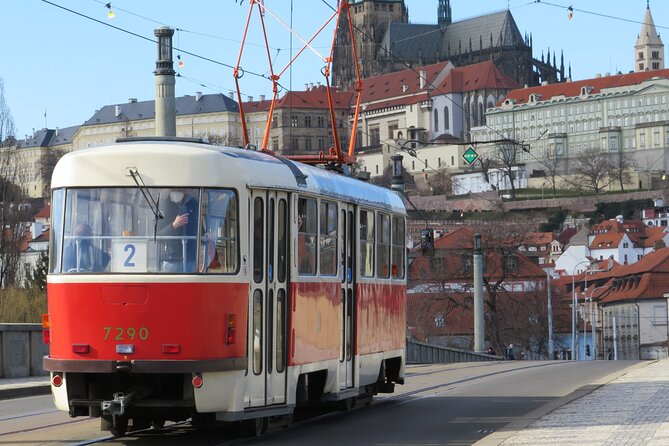
At $21.66 per person, the price is reasonable if you want interpretation rather than tickets. The listed stops do not require admission fees, so you are paying for Fergus’s time, research, organization, and ability to link scattered places into one story.
That value depends on your interests. A person looking only for famous monuments might get more from a conventional city walk. Someone who has already seen Prague Castle, the Astronomical Clock, and the main Old Town streets may find this route a better use of two hours because it changes the way familiar or overlooked places make sense.
The tour is also relatively short. Two hours leaves room for another activity on the same day, while the one-way route means you do not spend time circling back to the start. The ending near Charles Square and the river is useful for planning the rest of your afternoon.
There are no extra entry costs listed, but the information does not say that drinks, meals, or other purchases are included. Plan on paying for those separately if you want them.
Who should book this literary walk
I would choose this tour if you meet one or more of these descriptions:
- You enjoy literature but want historical and social context too.
- You are curious about Hrabal, Kafka, Kundera, or Czech literary movements.
- You have already seen Prague’s famous sights and want a less familiar route.
- You like walking tours built around stories, anecdotes, and discussion.
- You want an English-language activity that fits into a two-hour schedule.
- You live in Prague and want to understand the city beyond its buildings.
I would be more cautious if you dislike walking, need a fully disclosed list of subjects, or prefer a tour focused on architecture and major landmarks. The route is also not designed as a museum visit. Its main reward is the guide’s explanation of people and events connected to the streets around you.
The tour is listed as suitable for most people, with service animals allowed and public transportation nearby. Confirmation arrives at booking, and the group maximum is 25. Free cancellation is available until 24 hours before the start time. Changes or cancellations inside that window are not accepted for a refund.
Should you book Prague’s Literature Route?
Book it if you want Prague to become more than a pretty collection of streets. The strongest reason to go is the combination of Fergus’s storytelling and a route that brings together writers, political change, cultural conflict, and places outside the standard sightseeing circuit.
The experience is best for readers, history fans, repeat visitors, and curious walkers. It is less suitable for anyone expecting entry into major attractions or a broad introduction to every famous Prague landmark.
At $21.66 for two hours, the price is fair for a focused English walk with no added admission fees. If Hrabal, Kafka, Kundera, the avant garde, or the city’s multilingual past interests you, I would book it. If those names mean little to you, choose a general Prague tour first, then return to this one when you want the city’s quieter stories.
FAQ
How long does the Literature Route take?
The tour lasts approximately two hours.
What language is the tour offered in?
The tour is offered in English.
How much does the tour cost?
The listed price is $21.66 per person.
Where does the tour begin?
It begins at Mariánské nám. 2/2, 110 00 Praha 1-Staré Město, Czechia.
Where does the tour end?
The tour ends at Karlovo náměstí, near the New Town Hall and river promenades.
How many stops are included?
The route includes five stops: U Zlatého tygra, Bartolomějská, Slovanský ostrov-Žofín, Pštrossova, and Karlovo náměstí.
Are admission tickets included or required at the stops?
Each listed stop has free admission, so no admission ticket is required for those locations.
How large can the group be?
The tour has a maximum of 25 people.
Can I cancel for a full refund?
Yes. You can cancel at least 24 hours before the start time for a full refund. Cancellations or changes made less than 24 hours before the start time are not refunded or accepted.
Just added around Prague
- Prague: Historical Walking Tour with Focus on World War 2★ 4.3 · 12 reviews
- WWII and Communism History in Prague’s Old Town Private Tour★ 5.0 · 4 reviews
- World War II 4WD Tour from Prague with Lunch★ 4.4 · 3 reviews
- Unique salt cave in Prague★ 4.9 · 10 reviews
- Walking tour of Prague in French : Nové Město★ 4.9 · 16 reviews
- Walking tour of Prague in french: Old Town & Charles Bridge★ 4.9 · 62 reviews
- Prague: Market Tour and Traditional Czech Cooking Class★ 4.7 · 19 reviews
- Ultimate Unlimited Beer Pong with Czech Beer★ 4.6 · 5 reviews
Historical Tours, compared.
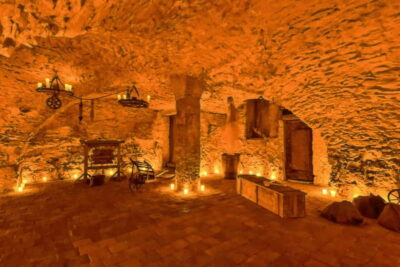
Oldtown, Medieval Underground & Dungeon History Tour
Read our review →
Prague Old Town, Medieval Underground and Dungeon Historical Tour
Read our review →
Communism History and Nuclear Bunker Guided Tour
Read our review →
Historic City Center Bus Tour with Top Sights
Read our review →
Prague Historic Pub Tour with Drinks Included
Read our review →
Prague Communism History and Nuclear Bunker Tour
Read our review →
Hop-on Hop-Off Historical Tram Ticket for Line 42
Read our review →
Top Sights and Historic Center Introduction Tour
Read our review →Browse the lists this tour appears in