
Reviewed · PRAGUE
The Plague Doctor of Prague
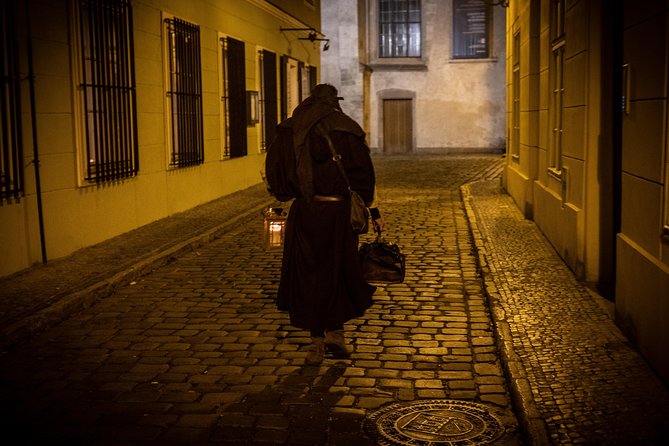
Prague’s plague doctor does more than pose for a spooky photograph. Over 90 minutes, you walk from the Old Town toward the Jewish Quarter and St. Agnes Convent while a costumed guide explains how people understood disease in the early 1700s. Faith, fear, medicine, and daily life all get a turn.
I like two things here. First, the guide stays at the center of the experience, so names such as David, Thomas, Oscar, Oskar, and Maddie matter. Their job is part history lesson, part street performance. Second, the route gives you a fresh look at familiar Prague sights, including Old Town Square, Klementinum, and the old hospital at Na Frantisku.
The main caution is that this is a theatrical walking tour, not a formal academic lecture. One participant wanted a stronger historical narrative, and another noted that the costume needed freshening. The format also works best if you enjoy dark humor and stories about illness.
Key points to know before booking
- The tour links six central Prague stops to the plague years, Jewish life, medicine, quarantine, and religion.
- The small group has a maximum of 10 people, which helps you hear the guide and ask questions.
- The guide’s performance matters, and past tours have featured David, Thomas, Oscar, Oskar, and Maddie.
- The mood is spooky but not grim, with humor mixed into serious material about death and public health.
- The walk is gentle enough for most fitness levels, and the full route lasts about 90 minutes.
- The $26.61 price is fair if you want both a guided walk through central Prague and a themed history lesson.
What the Plague Doctor of Prague actually offers
This experience uses Prague itself as the classroom. You are not simply told about the Black Death in a room. You move through streets, squares, churches, former medical sites, and the Jewish Quarter while the guide connects each place to the period’s beliefs and hardships.
The focus is especially strong on the plague outbreak associated with Prague in 1713 to 1715. The opening material also reaches back to wider plague history, including the different forms of the disease and the enormous death toll associated with outbreaks around the world.
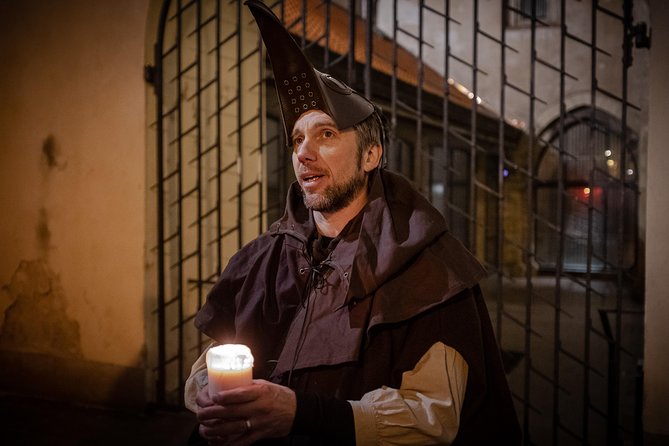
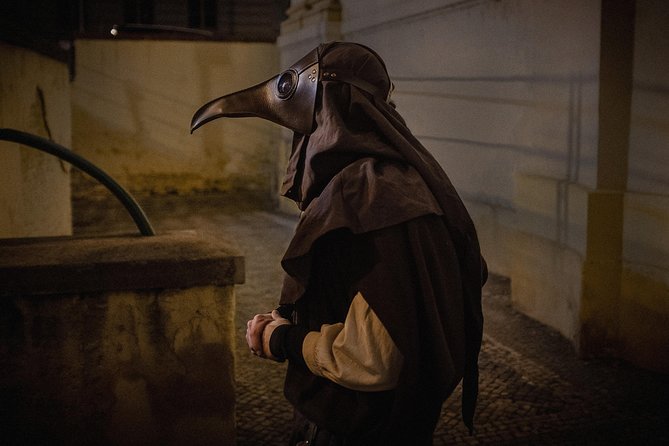
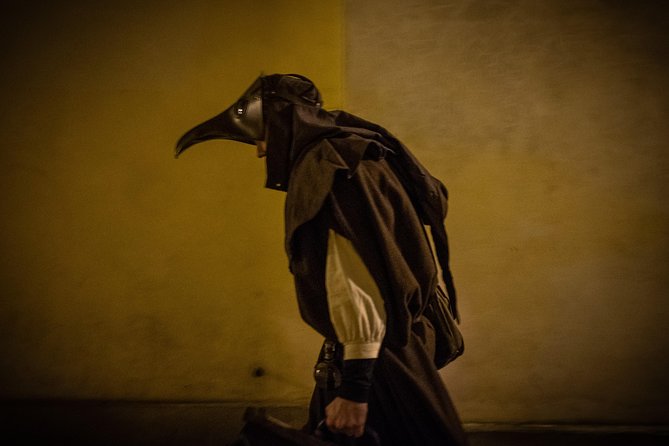
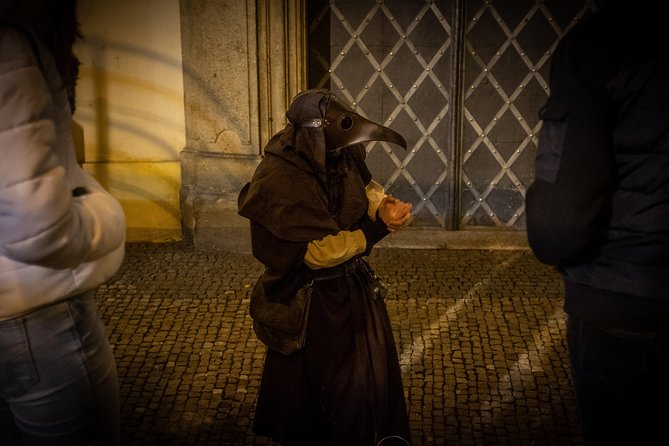
The guide wears a plague doctor costume and introduces himself as Alexander Schamsky at the start. That character gives the walk a clear shape. You are traveling back to 1715, but the information is presented for a modern audience, with references to medicine, public health, and the continuing status of the disease.
The best guides make this balance work. David is described as articulate, funny, and well prepared. Thomas brings an actor’s timing and takes care to involve the whole group. Oscar and Oskar have also led engaging versions, while Maddie is noted for presenting the material in a personal, accessible way.
Other Prague days people book alongside this one:
- Prague: 50-Minute Sightseeing Evening Cruise
★ 4.2 · 33,780 reviews - Prague: Medieval Dinner with Unlimited Drinks
★ 4.4 · 19,847 reviews - Prague: Skip-the-line Castle Ticket and Optional AudioGuide
★ 4.3 · 11,121 reviews
Starting at the House of the Golden Well
The meeting point is outside the Aurus Hotel at Karlova 3 in Old Town. The building is also known as the House of the Golden Well, and the first 10 minutes introduce both the site and the character of the plague doctor.
You learn about St. Sebastian and St. Rochus, two saints associated with protection from plague. The guide also explains what people once believed caused the disease. These ideas could involve sin, bad air, divine punishment, or other forces that made sense before modern germ theory.
This is a useful beginning because it shows how people made decisions with the information available to them. The plague was not only a medical crisis. It was also a crisis of faith, rumor, blame, and social order.
The opening stop is short, so do not expect a long examination of the hotel or its architecture. Its real purpose is to establish the character, the period, and the questions the walk will explore.
Klementinum, the New Town Hall, and life in quarantine
The second stop lasts about 10 minutes and brings in the old monastery Klementinum, its library, and the New Town Hall. These locations provide a setting for the practical side of the outbreak.
Here, the guide explains the different types of plague and compares the experience of wealthy people with that of ordinary residents. That contrast is one of the most useful parts of the tour. Money could affect where a person lived, how easily they escaped, and what care they could seek, but no one could simply purchase certainty.
You also hear about quarantine. The subject has clear meaning for modern audiences, but the tour places it in an earlier world without current medicine, rapid communication, or established public health systems. A quarantine order could isolate a household or neighborhood with little understanding of how the disease moved.
This section may feel more like a spoken lesson than a performance. Pay attention to the details about everyday restrictions and survival. They help turn a huge historical event into something more personal.
Old Town Square and the business of survival
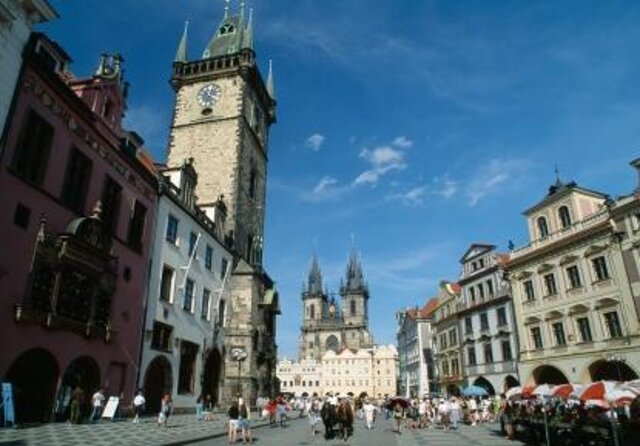
At Staromestske namesti, or Old Town Square, the guide introduces the large market area, the Hussite Church, Tyn Church, and Old Town Hall. This is the most recognizable part of the walk, and it adds a social and commercial angle to the story.
Merchants still had to deal with food, money, trade, and movement during plague years. A market square was a place of opportunity, but also a place where people gathered and disease could spread. The guide explains how merchants tried to keep working while facing fear and sudden limits on travel.
The conversation also reaches back to the Thirty Years’ War. That connection matters because disease did not occur in isolation. War, movement, poverty, and disruption could make outbreaks harder to control and could weaken the people most at risk.
This stop is less about identifying buildings in detail and more about showing how the city functioned under pressure. If your main goal is Prague architecture, a standard Old Town walk will give you more. If you want to see these landmarks as part of a social story, this tour adds a useful layer.
Same city, a completely different afternoon:
- Prague: Castle Tour with Local Guide and Entry Ticket
★ 4.6 · 10,422 reviews - Prague Castle 2.5-Hour Tour Including Admission Ticket
★ 4.7 · 8,927 reviews - Prague: Oldtown, Medieval Underground & Dungeon History Tour
★ 4.2 · 8,244 reviews - Prague: Vltava River Night Cruise with Buffet
★ 4.3 · 7,338 reviews
Franz Kafka, the Jewish Quarter, and Albert Camus
The short stop at the Franz Kafka statue shifts the focus to Jewish life during plague periods. After a brief introduction to Kafka, the guide discusses the treatment and experience of Jewish communities in Prague and across Europe.
This is an important part of the route. Disease often produced panic, and panic encouraged scapegoating. Jewish communities could face suspicion, exclusion, and violence even when there was no sound basis for blame. The tour does not treat the plague only as a medical event. It shows how an outbreak could expose existing prejudice and deepen it.
From the Kafka statue, the group enters the Jewish Quarter. The walk does not promise a full tour of the quarter’s synagogues or cemetery, so you should not book it as a replacement for a dedicated Jewish Prague visit. Instead, this section uses the area to discuss social pressure and the consequences of fear.
The guide also introduces Albert Camus’s novel La Peste. That literary link helps connect historical plague to later ideas about courage, responsibility, isolation, and human behavior during an epidemic. It is a brief part of the route, but it gives the subject a wider frame.
Na Frantisku and the harsh limits of old medicine
At the Church of Saint Simon and Jude, the tour turns toward the former hospital at Na Frantisku. This is the longest stop, at about 15 minutes, and it provides the clearest medical background.
You learn about methods used to treat plague and about the people who worked in the hospital. The tour also recognizes lesser-known medical figures who tried to care for the sick. That focus is welcome. Famous names often dominate historical stories, while nurses, doctors, attendants, and local caregivers carried much of the daily burden.
The guide discusses the disease that killed about 200 million people worldwide, according to the tour’s presentation. The number refers to plague deaths across major outbreaks and long periods of history, not to one Prague episode. Listen for that distinction, since the walk moves between local events and the broader story of plague.
The medical material can be creepy, but it is not presented only for shock value. You get a sense of how limited diagnosis and treatment were, why some methods failed, and why a doctor’s costume has become such a strong symbol of plague medicine.
The walking itself is manageable. One person specifically found the amount of walking suitable after a long day, and the route is described as workable for most fitness levels. Still, you will be outdoors for the whole experience, so sensible shoes and weather-appropriate clothing matter.
Finishing at St. Agnes Convent
The last stop is the National Gallery’s Convent of St. Agnes, where the guide introduces Agnes of Bohemia and her work. The tour then pulls together the earlier topics: plague beliefs, quarantine, class, Jewish life, medicine, and the wider effect on Europe.
Ending at a religious site makes sense. The tour began with saints and popular beliefs, moved through medical and civic responses, and finishes with a figure connected to care and service. You get a final look at how faith and practical aid overlapped in medieval and early modern society.
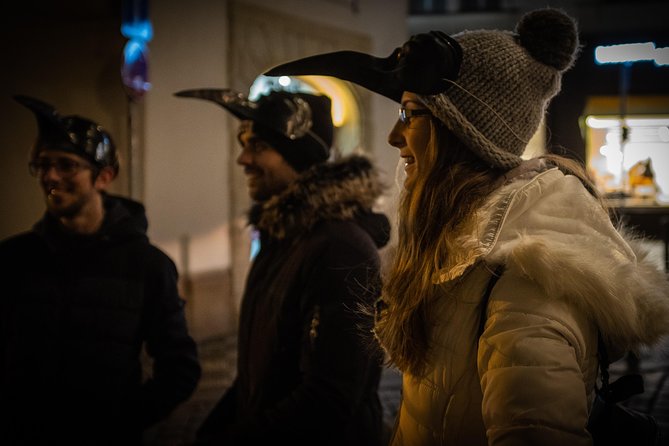
The guide also discusses the current status of plague. That gives the walk a modern public health angle without turning it into a contemporary disease lecture. The final group photograph with the plague doctor is a simple but effective finish.
The location is different from the starting point, so plan your evening around ending near St. Agnes Convent rather than returning to Karlova. The provided details do not specify a return transfer, and none should be expected from a walking tour.
How the guides shape the evening
This experience depends heavily on the person leading it. The costume creates the first impression, but the guide’s timing, clarity, and ability to answer questions determine how much you take away.
David has been praised for explaining the subject clearly and adding humor. Thomas is described as personable, funny, and attentive, with a performance style that helps the period feel close. Oscar and Oskar are noted for strong delivery and good command of the material. Maddie is described as well prepared and easy to follow.
The humor is usually dark rather than childish. That helps keep a difficult subject from becoming flat, but it will not suit every mood. Families with children and teenagers have found the format accessible, including a 10-year-old who especially enjoyed it. Still, parents should know that the topic includes death, disease, old medical practices, and social persecution.
The small maximum group of 10 is a real advantage. You are less likely to lose the guide’s voice at a crowded square, and questions are easier to handle. The tour is offered in English and uses a mobile ticket.
Price, pace, and practical value
At $26.61 per person, the tour sits in a reasonable range for a 90-minute guided experience in central Prague. You are paying for a costumed performance, a compact walking route, and a focused lesson that combines history, medicine, literature, and public health.
The value is strongest if you want something beyond a standard sightseeing circuit. The walk passes major places, but it does not spend most of its time on architecture. Instead, it asks how people lived, traded, worshipped, suffered, and reacted when normal life began to break apart.
The price is less compelling if you only want a serious lecture or a full architectural tour. One person felt the historical story needed more content, and that is a fair point. The tour touches many themes in a short time, so some subjects receive only a few minutes.
It is booked an average of 16 days ahead, which suggests you should not leave it until the last evening of a busy Prague visit. Free cancellation is available if you cancel at least 24 hours before the start time. Cancellations inside that window are not refunded. Poor weather or failure to meet the minimum group size can lead to a new date or a full refund.
The tour requires suitable weather and runs outdoors. Service animals are allowed, public transportation is nearby, and most people can take part. These details make it fairly easy to fit into a city break, but the booking information does not promise full step-free access at every stop.
Who should book this Prague walk
I would choose this tour if you like history with a clear human angle. It suits people interested in medicine, epidemics, public health, religion, literature, or the social effects of fear.
It also works well for families with older children and teens. The performance gives young people something to follow, while the subject offers more substance than a simple ghost walk. Adults who want a serious lesson should be ready for jokes and theatrical moments.
You may want a different tour if you dislike costumes, dark humor, or discussion of death. You may also prefer a standard Prague history walk if your priority is detailed architecture, royal history, or a long look at individual monuments.
The route is particularly useful early in your stay because it introduces several central areas, including Old Town and the Jewish Quarter. Do not treat it as your only orientation walk, but it can help you notice familiar streets in a different way later.
Should you book the Plague Doctor of Prague?
Book it if you want a compact evening walk that is informative, theatrical, and a little eerie. The strongest parts are the guide-led storytelling, the discussion of Jewish communities and quarantine, and the way the route connects familiar Prague places to ordinary people facing disease.
Go in expecting a lively performance rather than a university seminar. The historical coverage is broad, and the material sometimes moves quickly. At $26.61, a small group, a 90-minute route, and a memorable final photograph make it good value for the right audience.
If you are curious about how societies respond to catastrophe, this is a smart choice. If you only want pretty views or monument facts, spend your money elsewhere.
FAQ
Where does the Plague Doctor of Prague tour start?
It starts at the Aurus Hotel Prague, Karlova 3, 110 00 Praha 1, Staré Město, Czechia.
Where does the tour end?
The tour ends at a different location, at the National Gallery Prague, Convent of St. Agnes area. It does not return to the starting point.
How long does the experience last?
The walking tour lasts approximately 1 hour and 30 minutes.
What language is the tour offered in?
The experience is offered in English.
How large is the group?
The advertised maximum is 10 participants.
Is the tour suitable for children and teens?
Most people can participate, and the experience has been enjoyed by children, teenagers, and adults. The subject includes plague, death, disease, and old medical practices, with dark humor used during the presentation.
What happens if I need to cancel?
You receive a full refund if you cancel at least 24 hours before the start time. Cancellations or changes made less than 24 hours before the start are not refunded. If poor weather or an insufficient number of participants cancels the activity, you are offered another date or a full refund.
Just added around Prague
- Prague: Historical Walking Tour with Focus on World War 2★ 4.3 · 12 reviews
- WWII and Communism History in Prague’s Old Town Private Tour★ 5.0 · 4 reviews
- World War II 4WD Tour from Prague with Lunch★ 4.4 · 3 reviews
- Unique salt cave in Prague★ 4.9 · 10 reviews
- Walking tour of Prague in French : Nové Město★ 4.9 · 16 reviews
- Walking tour of Prague in french: Old Town & Charles Bridge★ 4.9 · 62 reviews
- Prague: Market Tour and Traditional Czech Cooking Class★ 4.7 · 19 reviews
- Ultimate Unlimited Beer Pong with Czech Beer★ 4.6 · 5 reviews