
Reviewed · WALKING TOURS
Prague: Highlights Walking Tour to the German embassy 1989
The most moving part of this Prague walking tour is its final chapter: the German Embassy, where East German refugees gathered in 1989 and Foreign Minister Hans-Dietrich Genscher announced that they could leave for West Germany. You see the building and the famous balcony from outside, then connect that scene to the streets, squares, and protests that brought communism down.
I like the way the route joins Prague’s major sights to real political events. Charles Bridge, the Old Jewish Town, Wenceslas Square, and Lennon Wall are not treated as disconnected photo stops. I also like the focus on Jan Palach and 1989, giving you a clearer sense of how Prague moved from Soviet control to the Velvet Revolution.
The main drawback is pace. In 150 minutes, you cover a lot of ground and make many brief stops. The German Embassy interior is closed to the public, and this walk is not suitable for people with mobility impairments.
Key points to know before you book
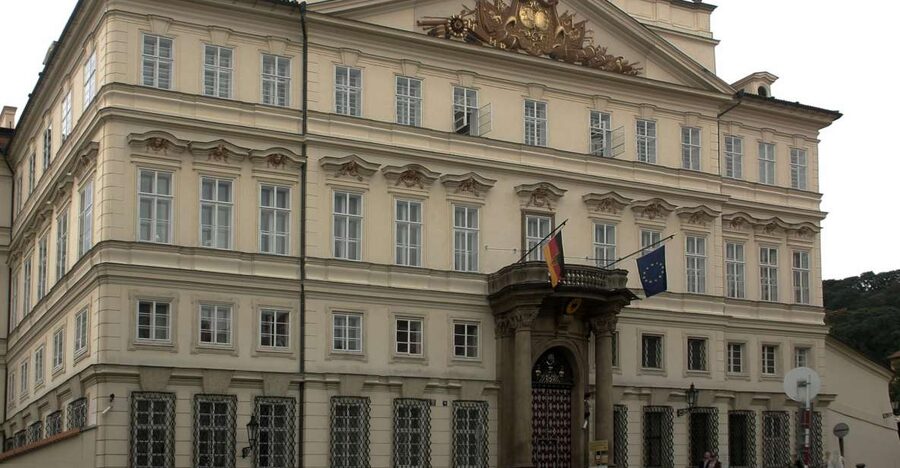
- The German Embassy is the emotional finish: See the building and balcony linked to Genscher’s 1989 speech, but not the embassy interior.
- The route covers three historic parts of Prague: You walk through the Old Town, Josefov, and Lesser Town.
- Jan Palach gives the tour its 1968 starting point: His story helps explain the Prague Spring and the cost of Soviet repression.
- You cross Charles Bridge on foot: This is a sightseeing walk, not a coach tour, so good shoes matter.
- The tour is conducted in German: A licensed German-speaking guide leads the experience, with private groups available.
- The price buys focused context rather than entry tickets: At $32 per person, the value rests in the guide and the connections between sites.
Why this route tells Prague’s modern story well
Many Prague walks concentrate on medieval architecture. This one uses the city center to explain the 20th century, especially the pressure points of 1968 and 1989.
You begin near the Faculty of Law at Charles University, then move through places shaped by Jewish history, student protest, religious freedom, music, and political change. The route does not stay in one neighborhood. That is useful because Prague’s modern story was not confined to a single square.
The walk also gives you a strong visual sequence. You start with the river and central Old Town, pass through Josefov, cross Charles Bridge, reach Lennon Wall in Lesser Town, and finish near the German Embassy. The movement from public square to embassy makes the final stop feel connected to everything before it.
At the same time, you should set the right expectations. This is not a museum tour with long indoor visits. Most stops are viewed from the street, with short explanations and photo breaks. If you want a slow architectural tour or extended time at each monument, this route may feel brisk.
More walking tours in Prague:
- Prague: 3-Hour Walking Tour of Old Town & Prague Castle
★ 4.7 · 5,696 reviews - Prague: Ghost Walking Tour Where Legends Come To Life
★ 4.4 · 5,253 reviews - Prague: Jewish Quarter Walking Tour with Admission Tickets
★ 4.7 · 3,729 reviews
Starting beside Charles University and the Vltava
The standard meeting point is in front of the Faculty of Law at náměstí Curieových 7 in Prague’s Old Town. From Staroměstská metro station, it is about 550 meters on foot. Tram 17 stops at Pravnická Fakulta, which is another practical option.
Some booking choices include pickup from a hotel in Prague 1, 2, or 3, or from the city center near Můstek. Pickup is not included in every option, so check the selected arrangement before you reserve.
The first listed stop is Čech’s Bridge. You get a guided look at the riverfront, with scenic views on the way. This is a short stop, about 10 minutes, so expect orientation and photographs rather than a long lesson in bridge design.
That short opening works well. You are placed in the city’s geography before the guide begins threading together the political story. You also avoid wasting the first part of the tour on a long transfer.
Josefov, the Old Jewish Cemetery, and the Old Town
The walk continues toward Josefov, Prague’s former Jewish ghetto. The Old Jewish Cemetery receives a photo stop of about 10 minutes, followed by another short stop in Josefov.
This part of the route broadens the tour beyond communism. Prague’s Jewish quarter carries centuries of history, and the compact streets help you see how old neighborhoods sit beside later political landmarks. The cemetery is viewed as part of the walking route, not treated as a full cemetery visit with extended time inside.
If you want to explore the Jewish Museum sites, synagogues, or cemetery in detail, plan a separate visit. This tour gives you an introduction and keeps moving. That tradeoff is sensible for a tour built around 1968 and 1989, but it limits the time available for close inspection.
Jan Palach Square and the cost of protest
Jan Palach Square is one of the most important stops on the walk. Here the guide introduces Jan Palach, a student at the Faculty of Philosophy, and explains his place in the story of the Prague Spring in 1968.
Palach became a symbol of protest after the Soviet-led invasion ended Czechoslovakia’s reform period. The subject is serious, and the square gives it a fitting setting. You are not simply hearing about an abstract political movement. You are standing in the city where students and citizens faced the consequences of trying to change the system.
The stop lasts about 10 minutes and includes a guided explanation and a photo pause. That time is enough for the main story, but you may want to ask questions if your interest is strong. The guide can help connect Palach’s action to the later public mood that led to the Velvet Revolution.
This is one of the tour’s strongest choices. It prevents the 1989 story from appearing out of nowhere. You first learn about the hopes and repression of 1968, then follow Prague toward the demonstrations of 1989.
Same city, a completely different afternoon:
- Prague: 50-Minute Sightseeing Evening Cruise
★ 4.2 · 33,780 reviews - Prague: Medieval Dinner with Unlimited Drinks
★ 4.4 · 19,847 reviews - Prague: Skip-the-line Castle Ticket and Optional AudioGuide
★ 4.3 · 11,121 reviews - Prague: Castle Tour with Local Guide and Entry Ticket
★ 4.6 · 10,422 reviews
The Velvet Revolution Memorial and Wenceslas Square
The route then reaches a Velvet Revolution memorial, where you spend about 15 minutes with the guide. The stop focuses on the peaceful movement that helped end communist rule in Czechoslovakia.
The memorial gives you a chance to pause and consider the difference between 1968 and 1989. The earlier reform movement was crushed by military force. In 1989, mass public pressure and political change moved through the city in a different way.
Wenceslas Square follows, with about 15 minutes for a visit and guided sightseeing. This broad central square has long been a place for public gatherings, and it is one of the best locations in Prague for understanding how crowds could become a political force.
The square is also a useful place to ask the guide for a clearer timeline. The tour deals with the Prague Spring, the rise and fall of communism, the refugee crisis, and the Velvet Revolution in a single outing. A short question can help you separate these events instead of letting them blur together.
The National Museum and the city’s public stage
The Prague National Museum is a brief photo stop of about five minutes. You do not have time for a museum visit on this tour, but the building helps anchor the route in Wenceslas Square.
The museum and square are connected to Prague’s public life, making this a useful external viewpoint. You see the architecture, learn why the area mattered during political change, and continue on foot.
Do not book this experience expecting museum admission. Food, drinks, and entrance tickets are not included. The tour’s value is the guide’s interpretation of public spaces, not access to indoor collections.
Crossing Charles Bridge toward Lesser Town
Charles Bridge is one of the route’s major highlights. You cross it on foot, stop for photographs, and hear more about Prague’s changing history. The planned stop is about 15 minutes, though the full crossing and movement between locations form part of the walking time.
The bridge is a natural hinge in the tour. Behind you are Old Town, Josefov, Wenceslas Square, and the locations tied to Palach and the Velvet Revolution. Ahead is Lesser Town, where Lennon Wall and the German Embassy bring the story closer to international events.
You should wear comfortable shoes. The route includes bridges, historic streets, and several stops in different parts of central Prague. The tour is not suitable for people with mobility impairments, and the schedule does not leave much room for a slow pace.
Charles Bridge can be crowded, but the guide’s role here is not only to point out statues or views. The bridge helps you understand the physical connection between Prague’s neighborhoods. You move from the center of national protest toward the diplomatic setting of the embassy.
Lennon Wall and the language of dissent
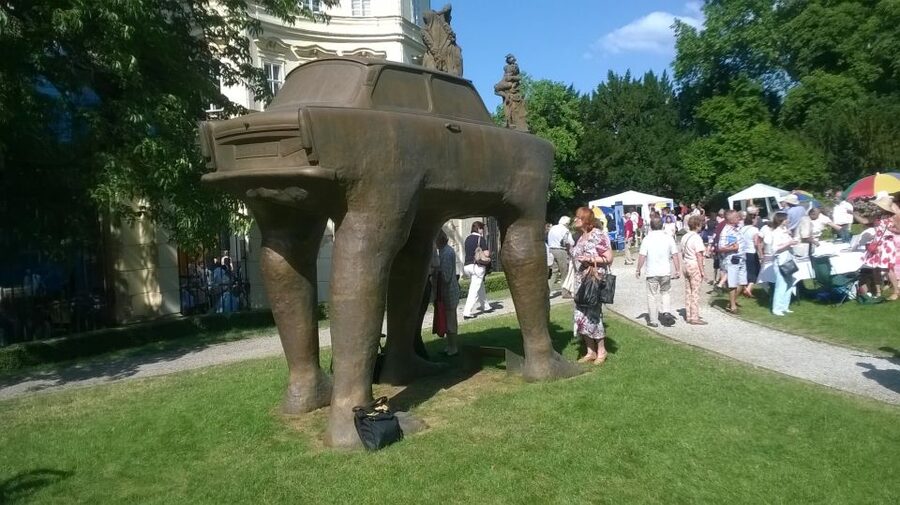
John Lennon Wall receives about 10 minutes of guided sightseeing and photographs. The wall is known for its changing messages, artwork, and tribute to Lennon, and it became associated with opposition to communist authority.
This stop adds a cultural side to the political story. Jan Palach represents direct personal protest. Wenceslas Square represents mass public action. Lennon Wall represents a more informal form of expression, using music, words, and images.
The wall is a short stop, so you should expect an overview rather than a detailed art discussion. Still, it provides a welcome change of mood after the heavier material about repression and death. It also shows how ordinary people used public space to express ideas that official institutions did not welcome.
Malostranské Square and the walk to the embassy
Malostranské Square is another brief sightseeing stop, listed at about five minutes. From here, the group continues on foot toward the German Embassy, with roughly 10 minutes of walking.
The route through Lesser Town gives you time to shift from Prague’s national story to the 1989 refugee crisis. East German citizens fled through Poland and Hungary toward the West German Embassy in Prague. Their presence turned the embassy grounds into a major focus of international attention.
This part is especially useful if you know the broad outline of the Cold War but not the Prague episode. The guide explains how people from East Germany reached the embassy and why their situation became so urgent. The tour places that crisis in the city rather than treating it as a distant event from a textbook.
The German Embassy and Genscher’s balcony
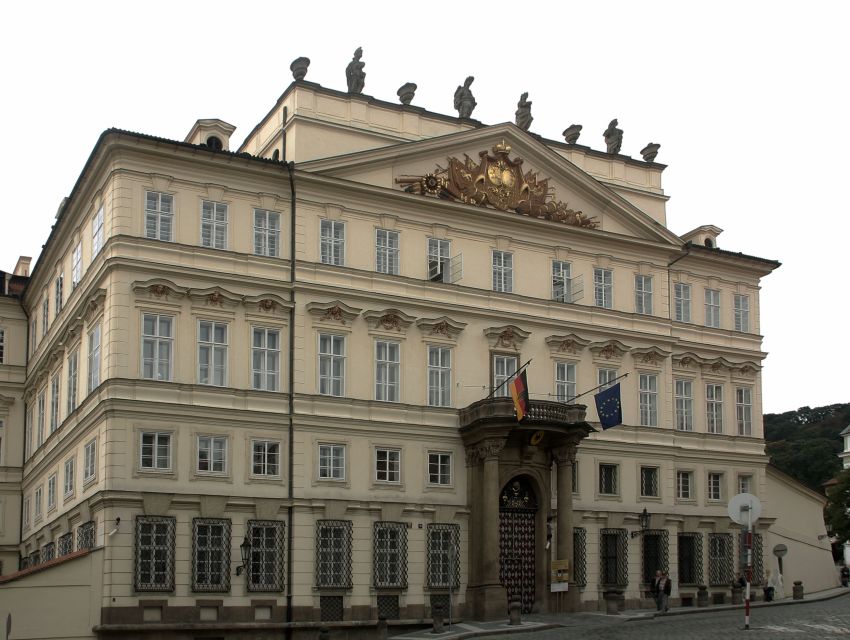
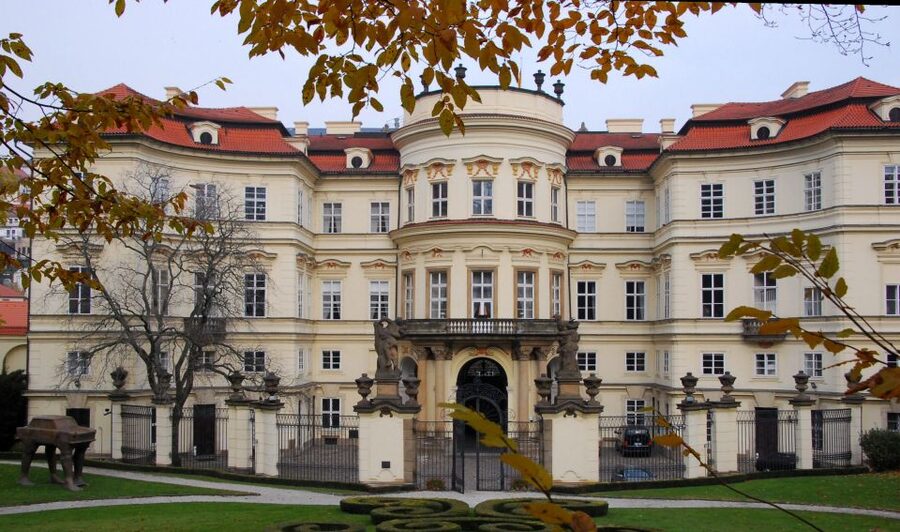
The German Embassy is the final major stop, with about 10 minutes for sightseeing and photographs. You see the embassy from outside and are shown the famous balcony associated with Hans-Dietrich Genscher, then West Germany’s Foreign Minister.
The embassy interior is not open to the public. You should think of this as an exterior historical site, with the balcony providing the key visual connection.
Genscher’s speech became famous because it brought the waiting East German refugees the news that they could leave for West Germany. The exact moment is powerful because the tour has already shown you Prague’s earlier struggles with reform, censorship, and protest.
One personal detail gives this stop unusual emotional weight. During a private tour in November 2024, a participant returned to the embassy after 36 years. She had been there with her parents in 1989 and had heard the joyful news from the balcony near Genscher. That detail helps explain why this is more than another city photo stop. For some people, the site is tied to a life-changing family memory.
The tour finishes at Malostranské náměstí. You are left in Lesser Town, well placed for continued sightseeing, although no onward transport or meal is included.
What the $32 price gets you
At $32 per person, this is a reasonable price for a 150-minute guided walk if you want historical explanation in German. You are paying for a licensed guide, route planning, and the links between sites. You are not paying for museum entries, food, drinks, or access to the embassy.
The value is strongest when you already plan to see Prague’s famous sights but want more than a quick photograph. Charles Bridge, Lennon Wall, Wenceslas Square, and the National Museum are all easy to recognize. The guide helps you understand why each place matters to the political story.
A private group option can make the price more worthwhile for families, colleagues, or people with a strong interest in German and Czech history. The named guide David led a private tour praised for clear information and for answering questions. That suggests a good fit for people who prefer conversation over a large, fixed group, though the available information does not promise that David will lead every departure.
The tour also offers free cancellation up to 24 hours before the start and a reserve now, pay later option. Those terms help if your Prague schedule is still shifting.
Who should book this Prague history walk?
I would choose this tour if you want a German-language introduction to Prague’s modern political history and also want to see the city’s essential central sights.
It suits you especially well if:
- You are interested in the Cold War, the Prague Spring, or the Velvet Revolution.
- You want to understand the 1989 German Embassy refugee crisis.
- You prefer a walking route with short stops instead of a long museum visit.
- You are comfortable walking across Charles Bridge and through central Prague.
- You value a private group or the chance to ask a guide questions.
- You speak German and want the tour delivered in that language.
I would look elsewhere if you need step-free access, want to enter the German Embassy, or prefer spending 30 minutes or more at each attraction. The route is full, and some stops are brief.
FAQ
Where does the tour meet?
The standard meeting point is in front of the Faculty of Law, Charles University, at nám. Curieových 7 in Prague’s Old Town.
How can I reach the meeting point by public transportation?
From the Staroměstská metro station, the meeting point is about 550 meters away. You can also take tram 17 and get off at Pravnická Fakulta.
How long does the walking tour last?
The tour lasts 150 minutes, or two and a half hours.
What language is the tour conducted in?
The tour is conducted in German by a licensed German-speaking guide.
Is hotel pickup available?
Optional pickup is available from hotels in Prague 1, 2, or 3, or from the city center near the Můstek metro station.
Does the tour enter the German Embassy?
No. The embassy interior is not open to the public. You see the building and the balcony from outside.
What happened at the German Embassy in 1989?
East German citizens fled through Poland and Hungary to the West German Embassy in Prague. Hans-Dietrich Genscher later announced from the embassy balcony that they could leave for West Germany.
Is the tour suitable for people with mobility impairments?
No. The activity is not suitable for people with mobility impairments.
Are meals and drinks included?
No. Food and drinks are not included.
Can I cancel the booking?
You can cancel up to 24 hours in advance for a full refund. A reserve now, pay later option is also available.
Should you book it?
Book this walk if you want Prague’s famous sights tied to the city’s modern struggles, especially the stories of Jan Palach, the Velvet Revolution, and the 1989 embassy crisis. The best reason to choose it is the route’s final connection between ordinary people seeking freedom and the balcony where Genscher delivered life-changing news.
At $32, it offers solid value for a German-language private or guided experience, but only if you are happy seeing most sites from the street and keeping to a steady walking pace. If that sounds right, bring comfortable shoes and leave room afterward to explore Lesser Town on your own.
Just added around Prague
- Prague: Historical Walking Tour with Focus on World War 2★ 4.3 · 12 reviews
- WWII and Communism History in Prague’s Old Town Private Tour★ 5.0 · 4 reviews
- World War II 4WD Tour from Prague with Lunch★ 4.4 · 3 reviews
- Unique salt cave in Prague★ 4.9 · 10 reviews
- Walking tour of Prague in French : Nové Město★ 4.9 · 16 reviews
- Walking tour of Prague in french: Old Town & Charles Bridge★ 4.9 · 62 reviews
- Ultimate Unlimited Beer Pong with Czech Beer★ 4.6 · 5 reviews
- Prague: Market Tour and Traditional Czech Cooking Class★ 4.7 · 19 reviews
Walking Tours, compared.
3-Hour Walking Tour of Old Town & Prague Castle
Read our review →
Ghost Walking Tour Where Legends Come To Life
Read our review →
Jewish Quarter Walking Tour with Admission Tickets
Read our review →
Prague Guided Walking Tour and Cruise with Authentic Czech Lunch
Read our review →
Old Town and Jewish Quarter Guided Walking Tour
Read our review →
Prague Ghost and Legend of Old Town Walking Tour
Read our review →
Prague 3-hour Afternoon Walking Tour including Prague Castle
Read our review →
Ghosts and Legends Nighttime Guided Walking Tour
Read our review →Browse the lists this tour appears in