
Reviewed · WALKING TOURS
Prague Art Nouveau and Cubism Walking Tour
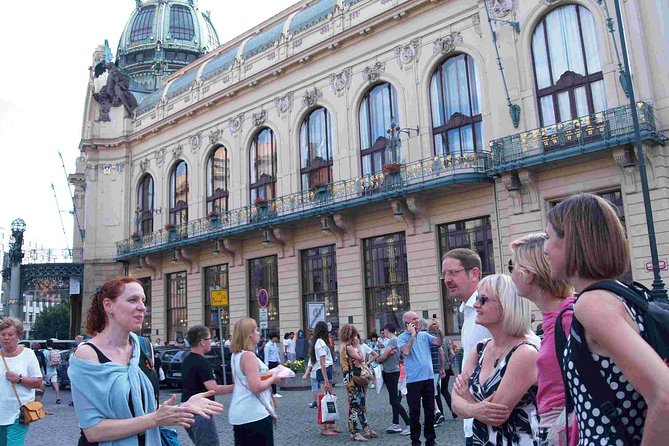
Prague’s architecture changes quickly on this walk. A Gothic building may sit near an Art Nouveau hotel, while a few steps later you are looking at the sharp geometry of Cubism. The tour teaches you to spot small details, such as ginkgo leaves on façades and elaborate interior lighting, that are easy to miss when you are simply crossing town.
I like the personal scale and the access to places such as Lucerna bar and Grand Hotel Europa. I also like the way the tour links architecture with cafés, restaurants, social life, and Czech national feeling, rather than treating buildings as pretty shells.
The main consideration is pace. Three hours gives you a lot of ground, and guides such as Robert keep the group moving. That works well for seeing more of Prague, but photographers may sometimes want extra time for careful shots.
Key points
- Art Nouveau details: Learn to recognize ginkgo leaves, curving lines, decorative façades, and ornate light fixtures.
- Two striking interiors: Visit Lucerna bar and Grand Hotel Europa, not just their exteriors.
- Cubist contrasts: Compare Art Nouveau with the House of the Black Madonna and the Bank of the Legions.
- Prague’s café culture: See how hotels, bars, restaurants, and stations served the city’s early international visitors.
- Strong local storytelling: Guides include Robert, Vadim Erent, and Bonita, with backgrounds in history, criticism, writing, and Prague life.
- Small-group feel: Private and small-group options make it easier to ask questions and reach less obvious interiors.
Why Prague’s Art Nouveau is best understood on foot
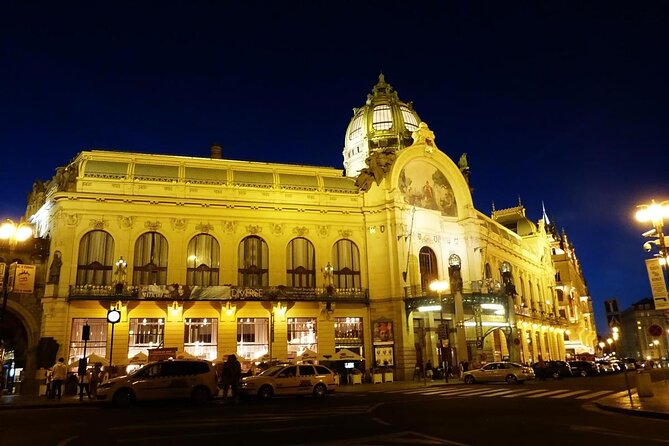
Prague is often praised for its older architecture, but the city’s Art Nouveau buildings tell a newer story. They belong to the years around the turn of the 20th century, when new materials, industrial wealth, travel, and urban confidence changed daily life.
On this three-hour walk, you learn to read that change from the outside in. Art Nouveau was not just a decorative style. It shaped hotels, cafés, restaurants, railway stations, apartment buildings, and public interiors. These were places where people met, ate, traveled, and showed that Prague belonged to the modern European world.
I find the walking format especially useful here. A guide can point from one façade to the next and show how details shift across a few streets. You get a clearer sense of the city’s development than you would from a single museum room or a quick sightseeing loop.
The tour begins at the House of the Black Madonna and Grand Café Orient on Ovocný trh in Prague 1. That is a fitting start because the building introduces you to Czech Cubism, while the wider route sets it against the softer curves and plant forms of Art Nouveau.
More walking tours in Prague:
- Prague: 3-Hour Walking Tour of Old Town & Prague Castle
★ 4.7 · 5,696 reviews - Prague: Ghost Walking Tour Where Legends Come To Life
★ 4.4 · 5,253 reviews - Prague: Jewish Quarter Walking Tour with Admission Tickets
★ 4.7 · 3,729 reviews
Starting at the House of the Black Madonna
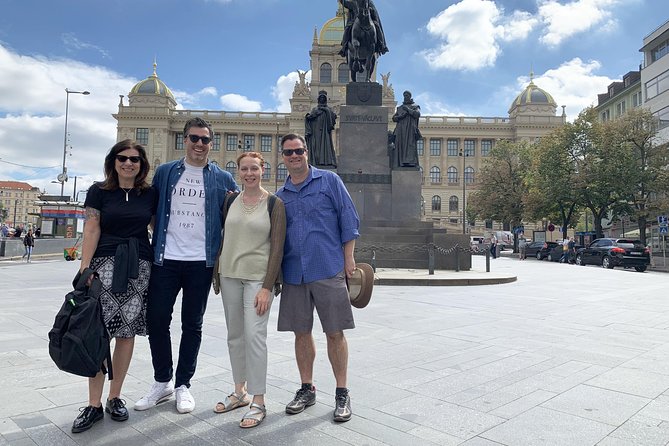
The House of the Black Madonna is one of the key Cubist buildings in Prague. Its name refers to the black Madonna sculpture on the façade, and its angular design gives you an immediate contrast with the flowing lines of Art Nouveau.
The building also contains Grand Café Orient, an important stop for understanding how architecture extends into interiors. Cubism in Prague was not limited to outside walls. It reached furniture, lamps, staircases, and cafés, creating a more geometric mood than the curling forms associated with Art Nouveau.
Your guide uses this opening stop to set up the main comparison. Art Nouveau favors organic shapes, floral decoration, and flowing ornament. Cubism breaks surfaces into angles and bold planes. The difference becomes much easier to see once someone points out what your eyes should look for.
This is also where the meeting arrangements matter. You meet downstairs at the front doors of the House of the Black Madonna, on the square. Arrive with enough time to locate the building, especially if you are coming through Prague’s busy central streets.
Learning to read Art Nouveau façades
The most useful part of the tour is the visual education. You learn to identify features instead of simply being told that a building is Art Nouveau.
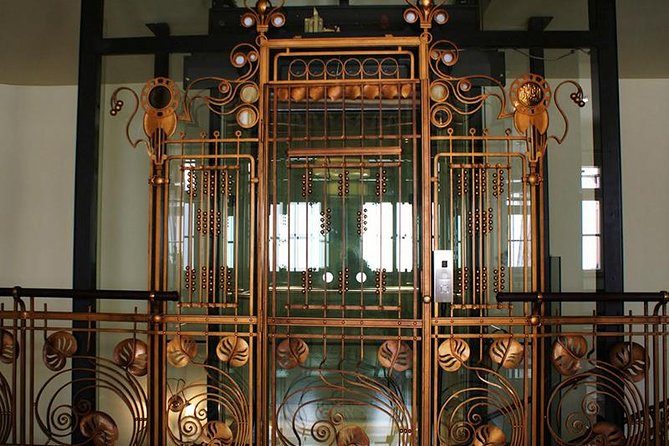
Look for plant motifs, sweeping curves, decorative ironwork, stained glass, sculpted figures, and carefully designed lettering. Ginkgo biloba leaves are a particularly useful clue. Their presence reflects the style’s interest in plant forms and its taste for decorative influences from beyond Europe.
The tour also draws attention upward. Prague’s Art Nouveau details often sit above street level, where a hurried walker may never notice them. You may find floral patterns around windows, elaborate balconies, colorful mosaics, and ornament that ties one floor to the next.
Interiors matter just as much. Elaborate light fixtures are a major part of the style because Art Nouveau designers treated practical objects as works of art. A lamp, doorway, railing, or wall panel could carry the same decorative language as the façade outside.
I like this approach because it stays useful after the tour. Once you know the visual clues, you can recognize them elsewhere in Prague, including buildings you pass without a guide.
Lucerna bar and the public life of the city
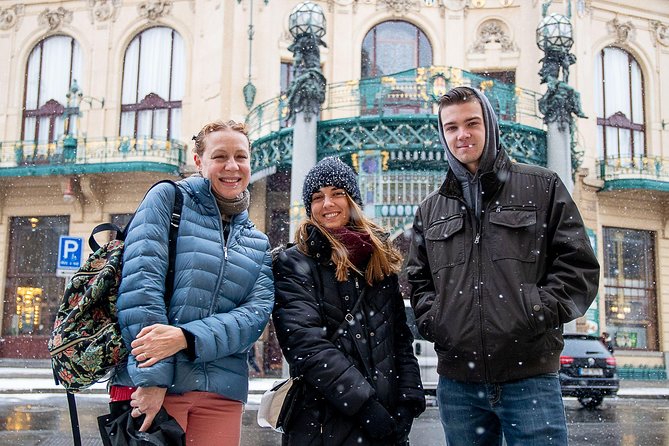
Lucerna bar gives the walk an indoor pause and a closer look at the spaces where Prague’s social life took place. The city’s Art Nouveau buildings were often hotels, restaurants, cafés, and bars because these were the places where modern urban society gathered.
That point adds needed context. The style was not created only for private mansions or grand official buildings. It was part of public life, and the people using these spaces helped define its meaning.
The tour connects such interiors with the pre-war social elite and the first globetrotters. In the early 20th century, improved transport and industrial growth made international travel more possible for wealthy visitors. Hotels and railway stations became stages for this new culture of movement.
Lucerna helps you picture the social side of the architecture. Instead of seeing ornament as decoration without purpose, you can understand it as part of an atmosphere designed for meeting, dining, and being seen.
The indoor stops are also practical in cold weather. A December group led by Robert was able to go inside buildings for detailed looks and short warm-up breaks. That does not turn the walk into an indoor tour, but it makes the experience more manageable in winter.
Same city, a completely different afternoon:
- Prague: 50-Minute Sightseeing Evening Cruise
★ 4.2 · 33,780 reviews - Prague: Medieval Dinner with Unlimited Drinks
★ 4.4 · 19,847 reviews - Prague: Skip-the-line Castle Ticket and Optional AudioGuide
★ 4.3 · 11,121 reviews - Prague: Castle Tour with Local Guide and Entry Ticket
★ 4.6 · 10,422 reviews
Grand Hotel Europa and the age of elegant travel
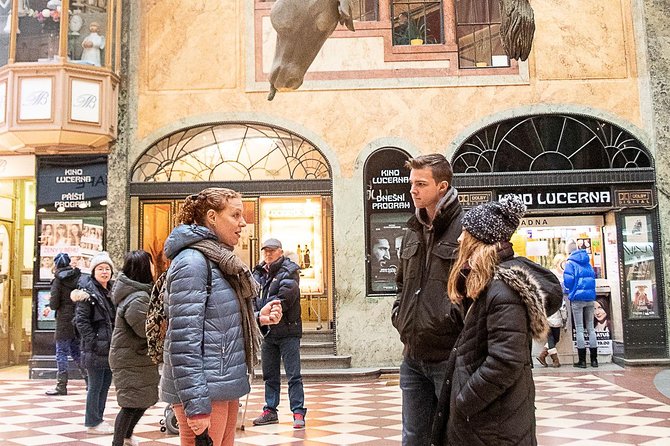
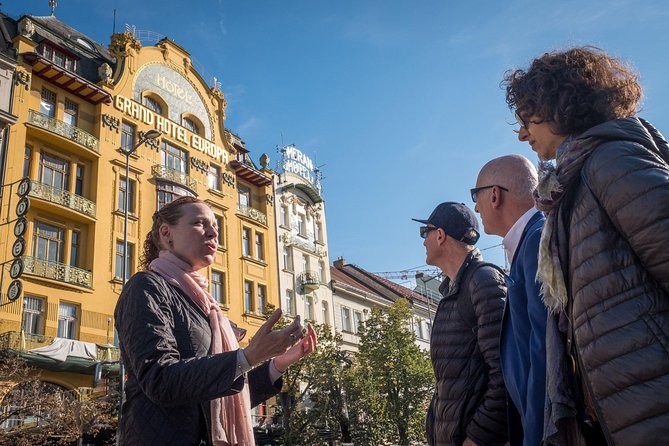
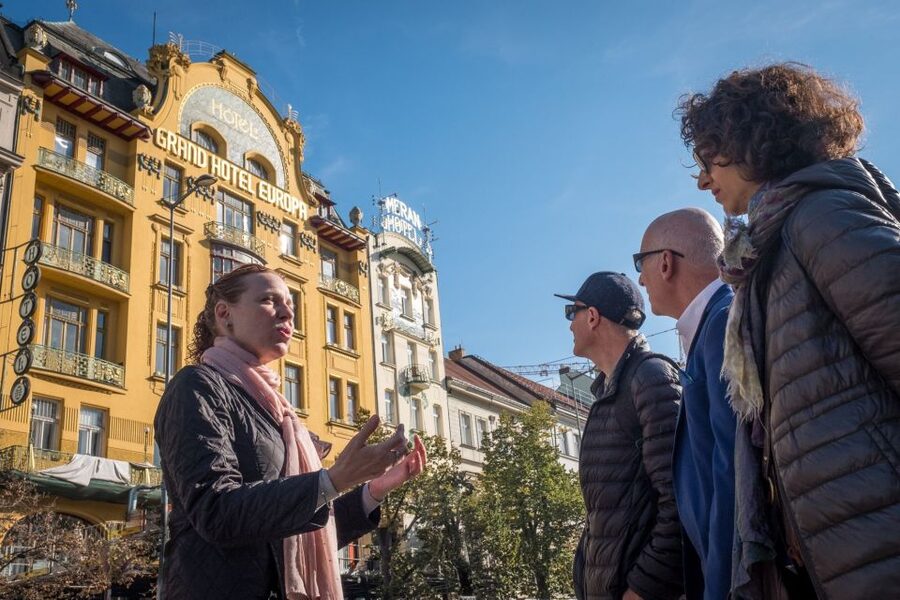
Grand Hotel Europa shows why hotels are so important to Prague’s Art Nouveau story. A grand hotel had to do more than offer a bed. Its façade, lobby, lighting, and public rooms announced a certain level of comfort and modern taste.
The stop helps explain why so much Art Nouveau architecture appears in places linked to travel. Hotels welcomed visitors from outside Prague, while stations carried people into the city. Restaurants and cafés gave them places to spend time once they arrived.
You should pay attention to the relationship between the decorative details and the building’s purpose. Curved lines, rich ornament, and stylish fixtures create a sense of occasion. This was architecture meant to impress, but it was also built around everyday activities such as eating, meeting friends, checking into a hotel, or catching a train.
Grand Hotel Europa is particularly useful in comparison with the Cubist buildings earlier in the route. Art Nouveau seeks movement and natural forms. Cubism gives you a harder, more intellectual visual language. Seeing both in central Prague makes the contrast memorable.
From Art Nouveau to Cubism and Rondo-Cubism
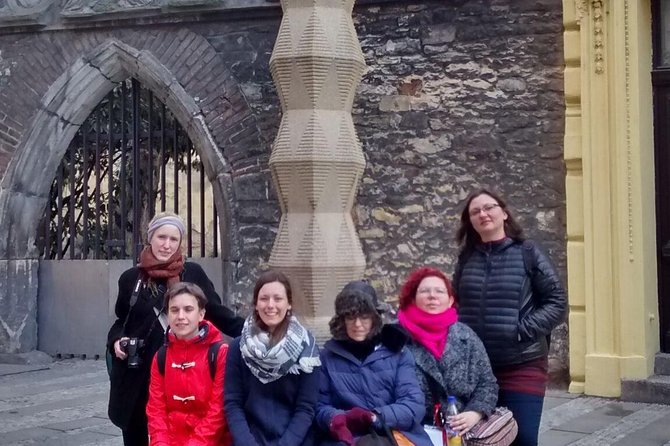
The tour does not treat Art Nouveau as an isolated style. It places it within a longer sequence of architectural change, from older Prague traditions through Art Nouveau and into Cubism and Rondo-Cubism.
The Bank of the Legions is one of the important comparisons. Its design helps show how Czech architects adapted Cubist ideas into a more national architectural language. Rondo-Cubism uses rounded geometric forms and decorative patterns that differ from the sharper look of earlier Cubism.
This shift reflects more than changing taste. Architecture became tied to Prague’s sense of modern sophistication and to a renewed Czech national identity. Buildings could look forward while also expressing a distinct local culture.
That is why a strong guide matters. Robert has been praised for explaining how architectural styles changed from Gothic through Art Nouveau, while Vadim Erent is known for drawing wider connections between architecture, social history, and Czech identity. Their approach turns a sequence of buildings into a readable story.
Bonita, another guide associated with this experience, has lived in Prague for many years and focuses on details that are easy to miss when you walk alone. The guides’ backgrounds include professors, doctoral students, historians, journalists, art critics, and published authors, so the tone is more like a moving architecture seminar than a standard sightseeing script.
Passages, cafés, and less obvious interiors
Central Prague is full of passages and courtyards that can be easy to overlook. A good guide uses these spaces to show how the city works behind its main façades.
The route may include student cafés, back courtyards, and other tucked-away places that help connect architecture with ordinary city life. One version of the tour included a university grand hall and an underground chapel, while another guide pointed out Roman ruins and frescoes. These details suggest that the exact route can vary with the guide, access, and the group’s interests.
You should not assume every extra stop is guaranteed. The confirmed focus is Art Nouveau and Cubism, with Lucerna bar and Grand Hotel Europa among the named highlights. Still, the possibility of added interiors is one reason a private or small group can be more rewarding than a large fixed route.
The smaller format also lets you ask about things that catch your eye. You might want to know why a certain doorway uses geometric forms, how a café served its original customers, or what changed after the First World War. A good guide can follow those questions without losing the main thread.
How the three-hour pace feels
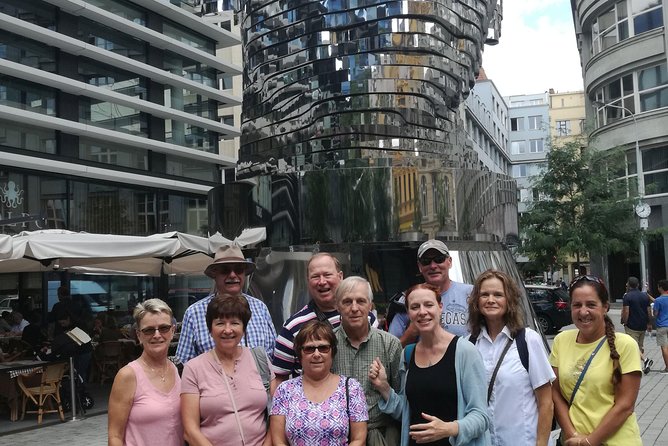
Three hours is long enough to build a proper story but short enough to fit into a day of sightseeing. You spend most of the time walking, looking, and listening, with indoor stops that break up the route.
Robert is described as keeping groups moving rather than leaving them standing in one place for long stretches. That is usually a strength. Prague’s central streets offer more to see when you move between examples, and walking can feel less tiring than standing still while a guide gives a long lecture.
There is a trade-off for photographers. You may need to take quick pictures while the group is ready to continue. If a façade matters to you, say so and ask for a moment, but do not expect the rhythm of a dedicated photography tour.
The walk works best when you wear comfortable shoes and dress for the weather. Cold conditions are more manageable because of the interior stops, but the experience remains an outdoor walking tour.
What the $123 price means
At $123 per person, this is not a budget introduction to Prague. The value depends heavily on your interest in architecture and on your group size.
For a private group or a small party that wants detailed explanations, the price can make sense. You are paying for three hours with a guide who may be a historian, critic, writer, or academic, rather than for a quick list of building names.
The price is harder to justify if you mainly want a general overview of Prague or prefer to move at your own pace. You can see many façades without paying for a tour. What you cannot easily reproduce alone is the connection between design details, social life, travel, and Czech identity, plus access to interiors that may not be obvious from the street.
The strongest value comes when you ask questions and treat the walk as an introduction to reading the city. Afterward, you can use the same skills on your own, spotting Art Nouveau ornament and Cubist geometry throughout central Prague.
Who should book this Prague architecture walk
I would recommend it most strongly if you have already seen Prague’s main landmarks and want a sharper understanding of the city’s early modern period. It also suits anyone who enjoys design, city history, cafés, or the story behind public buildings.
It is a good fit for:
- Architecture students and design fans
- Visitors interested in Art Nouveau, Cubism, or Rondo-Cubism
- Repeat visitors who want places beyond the usual viewpoints
- Small groups that prefer conversation over a large scripted tour
- People who like social history as much as façades
- Visitors willing to walk for three hours and keep up with the guide
You do not need specialist training. The guide explains the visual language in plain terms, and the comparisons make the ideas easier to follow.
Final decision: is the tour worth your time?
Book this tour if you want to understand why Prague looks the way it does, not simply photograph attractive buildings. The best parts are the side-by-side comparison of Art Nouveau and Cubism, the indoor stops at Lucerna bar and Grand Hotel Europa, and the connection between architecture and the people who used these places.
Skip it if you want a relaxed, stop-and-start walk with lots of time for photos. The pace is active, and the focus is architectural detail rather than Prague’s broadest list of sights.
For the right reader, the $123 fee buys a more personal way to see the city. Robert, Vadim Erent, and Bonita bring different backgrounds to the route, but the shared strength is clear explanation with room for questions. With a full rating from 29 reviews, this is one of the stronger choices for a focused Prague architecture experience, especially in a private or small group.
FAQ
Where does the tour begin?
The meeting point is at the House of the Black Madonna and Grand Café Orient, downstairs at the front doors on the square, at Ovocný 19 in Prague 1.
How long is the tour?
The guided walking tour lasts three hours.
What language is the tour offered in?
The tour is offered in English.
Which buildings and interiors are included?
The experience includes the House of the Black Madonna, Lucerna bar, Grand Hotel Europa, and comparisons with the Bank of the Legions. The exact route can include other interiors and locations.
Who leads the tour?
Guides associated with the experience include Robert, Vadim Erent, and Bonita. The guide team includes professors, doctoral students, historians, journalists, art critics, and published authors.
Is a private or small group option available?
Yes. The tour is available for private groups or small groups.
Just added around Prague
- Prague: Historical Walking Tour with Focus on World War 2★ 4.3 · 12 reviews
- WWII and Communism History in Prague’s Old Town Private Tour★ 5.0 · 4 reviews
- World War II 4WD Tour from Prague with Lunch★ 4.4 · 3 reviews
- Unique salt cave in Prague★ 4.9 · 10 reviews
- Walking tour of Prague in French : Nové Město★ 4.9 · 16 reviews
- Walking tour of Prague in french: Old Town & Charles Bridge★ 4.9 · 62 reviews
- Prague: Market Tour and Traditional Czech Cooking Class★ 4.7 · 19 reviews
- Ultimate Unlimited Beer Pong with Czech Beer★ 4.6 · 5 reviews
Walking Tours, compared.
3-Hour Walking Tour of Old Town & Prague Castle
Read our review →
Ghost Walking Tour Where Legends Come To Life
Read our review →
Jewish Quarter Walking Tour with Admission Tickets
Read our review →
Prague Guided Walking Tour and Cruise with Authentic Czech Lunch
Read our review →
Old Town and Jewish Quarter Guided Walking Tour
Read our review →
Prague Ghost and Legend of Old Town Walking Tour
Read our review →
Prague 3-hour Afternoon Walking Tour including Prague Castle
Read our review →
Ghosts and Legends Nighttime Guided Walking Tour
Read our review →Browse the lists this tour appears in