
Reviewed · PRAGUE CASTLE TOURS
Private Prague Castle Walking Tour
Prague Castle is not one building but a hilltop world of churches, palaces, gardens, fortifications, and royal stories. This private three-hour walk takes you from the Royal Garden into the castle complex, where Romanesque, Gothic, Renaissance, Baroque, Rococo, and Neoclassical buildings sit side by side. The best part is the chance to ask questions and slow down when something catches your eye.
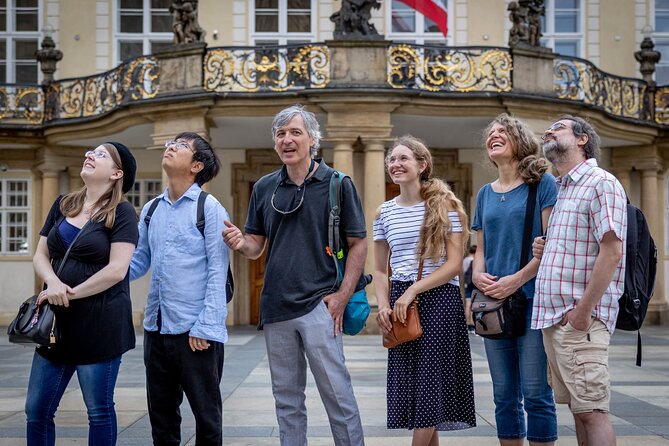
I like the private format, especially if you want more than a quick list of dates and names. Guides such as Vadim have adjusted the pace for groups with a serious interest in history, while other guides have made room for rain delays, tram rides, and short café breaks. I also like the afternoon option, since the castle can be less crowded later in the day.
The main drawback is cost. At $397.36 for a group of up to 10, the tour can be good value for a full group, but less so for one or two people. Prague Castle admission is extra, and three hours on steep paths and hard floors can be tiring.
Key points to know before booking
- A private historian leads the way: You get one guide for your group rather than a large shared party.
- The route covers the major castle sights: Expect St. Vitus Cathedral, the Old Royal Palace, St. George’s Basilica, Golden Lane, the Royal Garden, and city views.
- Afternoon may be the smarter choice: The castle complex is often quieter later in the day.
- Admission costs extra: Adults pay CZK 450, while students and seniors pay CZK 300.
- Central pickup can simplify the start: Your guide may meet you at a central hotel or flat, or at Bagel Lounge Malostranská.
- The tour works best for curious first-time visitors: You get a clear introduction, with room to focus on architecture, politics, art, or personal stories.
Why Prague Castle makes a strong first tour
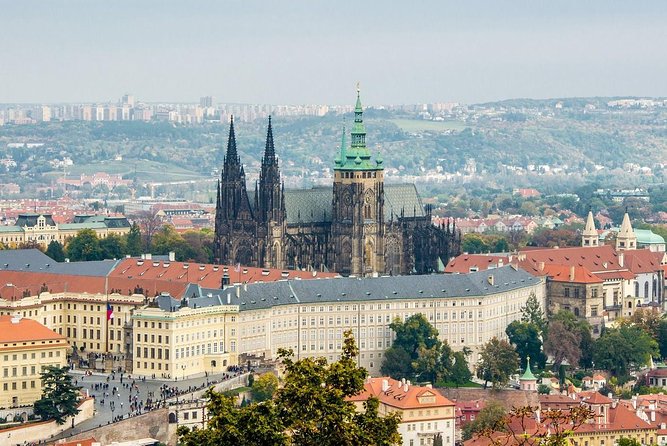
If you have limited time in Prague, this is a sensible place to begin. The castle sits above the city, and its buildings explain much of the country’s political and religious story. You also get an early look at the city from above, which helps you make sense of Prague’s layout.
The complex dates back about 1,100 years and is described as the largest castle complex in the world. That claim can sound grand, but the practical point is simple: you are not just walking into a palace. You are crossing a district-sized collection of buildings that changed purpose and style over many centuries.
A private guide matters here because the castle can feel like a pile of impressive façades without context. Your guide can explain why one building looks Romanesque, another Gothic, and another Renaissance. The stories also add life to the stone: artillery attacks, invading armies, royal residents, neglect under Austrian rulers, and political conflicts that shaped Central Europe.
The tour is offered in English, with morning and afternoon departure choices. Pickup is available from a centrally located hotel or flat. If your accommodation is farther away, the meeting point is in Lesser Town, and the guide can lead you by foot, tram, or metro. Tickets for that local transport are provided if you do not already have a pass.
More ways up to Prague Castle:
- Prague Castle 2.5-Hour Tour Including Admission Ticket
★ 4.7 · 8,927 reviews - Prague: 3-Hour Walking Tour of Old Town & Prague Castle
★ 4.7 · 5,696 reviews - Prague: 3-Hour Old Town and Prague Castle Tour in German
★ 4.8 · 5,671 reviews
Starting through the Royal Garden and Stag Moat
The walk begins at the Royal Garden and crosses the Stag Moat on the way toward the castle. This is a better approach than simply arriving at the main entrance and rushing toward the first grand courtyard. You begin with space, greenery, and a sense of how the castle sits above the city.
The Royal Garden contains several buildings worth a pause. The Renaissance Ball Game Hall recalls a time when aristocrats played tennis with the emperor. Its exterior sgraffito shows allegories of virtues, arts, and sciences, giving you a quick lesson in how Renaissance decoration used images to express political and moral ideas.
Nearby, Queen Anne’s Summer Palace is one of the purest examples of Renaissance architecture outside Italy. Ferdinand I commissioned it in the mid-1500s, and Rudolf II later converted it into an astronomical observatory. The names connected with the building include Tycho de Brahe and Johannes Kepler, along with Rudolf II himself.
These stops are short, about 10 minutes each, but they make the approach worthwhile. You are not seeing only the famous cathedral and palace rooms. You are also seeing the quieter edge of the complex, where royal recreation, science, and garden design shaped castle life.
St. Vitus Cathedral, Prague’s Gothic centerpiece
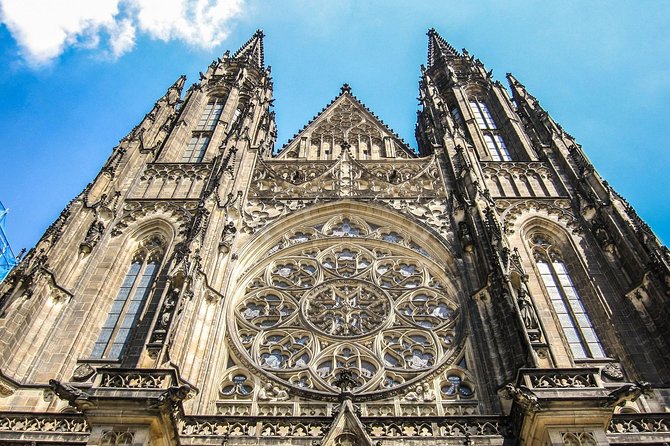
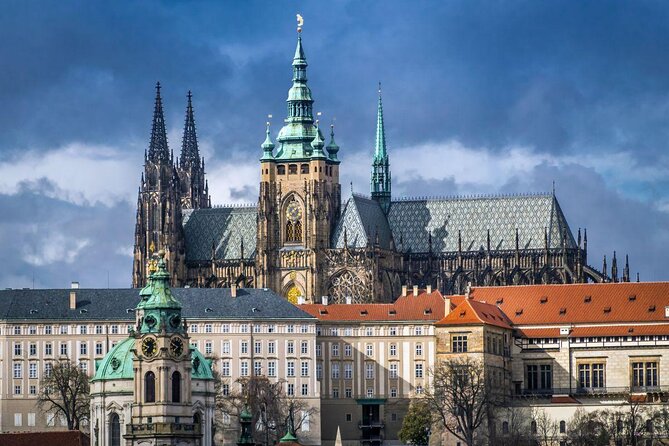
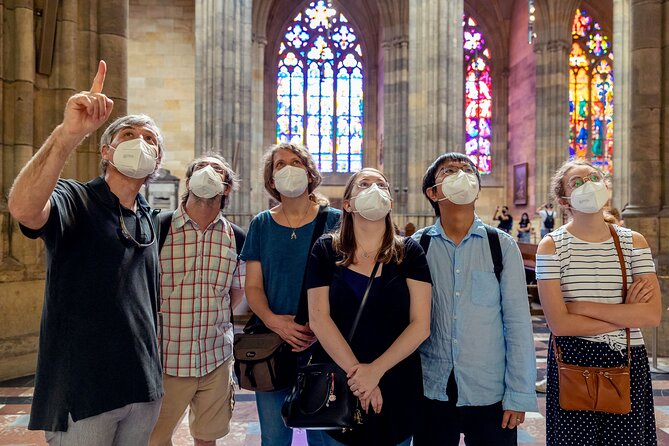
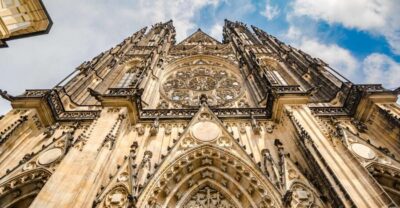
St. Vitus Cathedral is the visual and spiritual heart of the castle. It was founded in the first half of the 14th century but took roughly 600 years to complete. That long building period helps explain the layered feel of Prague Castle, where one project could continue across several political eras and architectural fashions.
Inside, the cathedral is tied to Czech sovereigns and patron saints. The royal crypt gives the building a direct connection to the country’s rulers, while the Gothic Chapel of St. Wenceslas holds relics of the saint. You can also see the Baroque tomb of St. John of Nepomuk, made of silver.
Your guide’s role is especially useful here. Without context, it is easy to notice only the scale, stained glass, and stonework. With an explanation of the cathedral’s construction and royal associations, you can understand why it became such a major symbol of Czech identity.
Plan for about 30 minutes at the cathedral. Admission is not included in the tour price, so you will need to budget for the required castle ticket. Since the cathedral is one of the main reasons many people visit the complex, check that the entrance ticket you purchase covers the interiors included in your planned route.
Vladislav Hall and the window that changed Europe
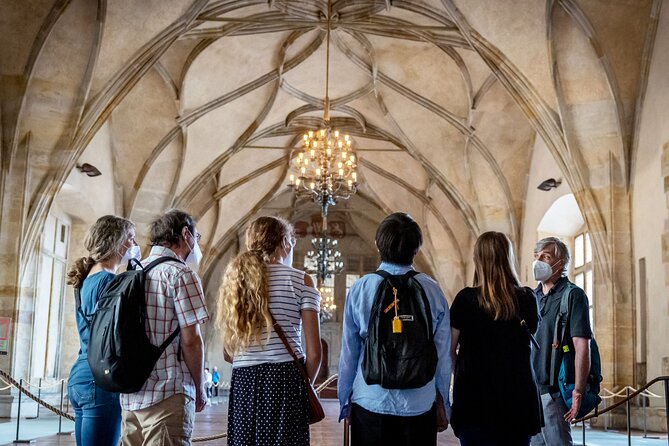
The Old Royal Palace gives the tour a strong political edge. Its centerpiece is Vladislav Hall, completed at the end of the 15th century. The room blends Late Gothic design with the newer Renaissance style, and its large scale reflects the ceremonies held there: coronation celebrations, banquets, and knights’ tournaments.
Look for the Riders’ Staircase, built wide enough for armored horsemen to enter the hall. That detail makes the room easier to picture as a working royal space rather than a grand but empty chamber.
The most dramatic stop is the window associated with the Defenestration of Prague. In 1618, members of the Czech Estates threw two Austrian governors and their scribe from a window. The event helped set off the Thirty Years’ War, one of Europe’s most destructive conflicts.
This is a good example of why a private guide adds value. The window itself is not the whole story. You need the political background to understand why a violent act at Prague Castle had consequences far beyond the building. Allow about 30 minutes here, with admission extra.
More walking tours in Prague:
- Prague: Ghost Walking Tour Where Legends Come To Life
★ 4.4 · 5,253 reviews - Prague: Jewish Quarter Walking Tour with Admission Tickets
★ 4.7 · 3,729 reviews - Prague Guided Walking Tour and Cruise with Authentic Czech Lunch
★ 5.0 · 3,627 reviews - Prague: Old Town and Jewish Quarter Guided Walking Tour
★ 4.6 · 2,847 reviews
St. George’s Basilica and a sharp change in style
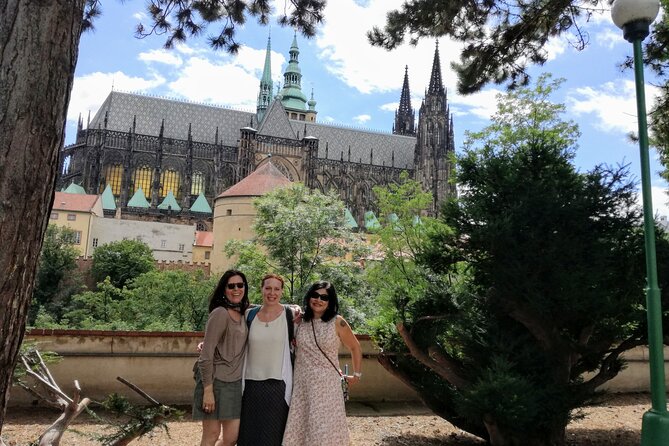
St. George’s Basilica offers a useful contrast with St. Vitus Cathedral. The basilica dates to the 12th century and has a Romanesque character: sturdy, austere, and monumental rather than soaring and ornate.
Seeing the two churches close together lets you compare styles without needing a textbook. St. Vitus reaches upward with Gothic drama, while St. George’s feels older and heavier. The contrast is one of the most rewarding parts of the route for anyone interested in architecture.
The visit here is short, around 10 minutes. That is enough for an introduction, but not a long study of every feature. If Romanesque churches are a major interest, tell your guide at the start. The private format makes that sort of adjustment possible, although the total tour still lasts about three hours.
Golden Lane and the castle’s smaller stories
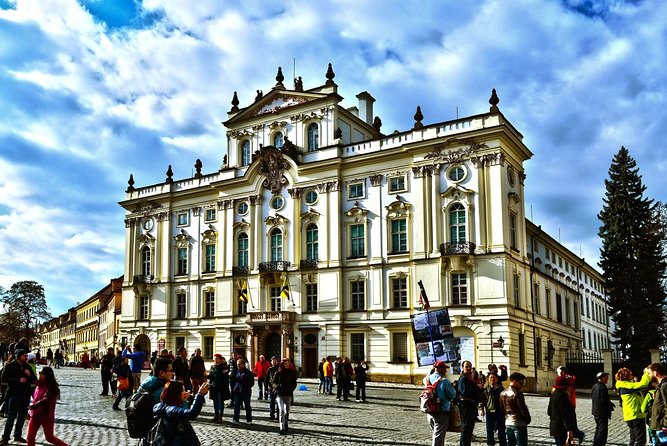
Golden Lane is the most picturesque stop, but it is also easy to misunderstand. Its tiny houses were built in the 16th century for castle guards connected with Rudolf II’s court. Today, many of the small rooms hold souvenir shops, so the lane has a more commercial feel than its old name may suggest.
You can also reach a medieval armor museum through the former 14th-century fortification. Golden Lane connects with Dalibor Tower, once used as a dungeon. These details give you a look at the less ceremonial side of castle life: guards, fortifications, prisoners, and cramped quarters.
Allow about 20 minutes. The lane can be crowded, and the small interiors are not built for lingering with a large group. With a private guide, you can ask which rooms are worth your time and move on when the displays begin to feel repetitive.
Views across Prague and the value of a private route
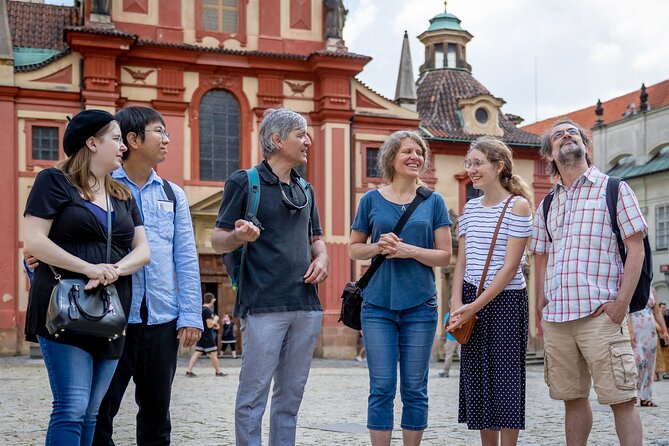
The castle’s height provides wide views over Prague. You will see the city spread below from several points around Hradčany Hill, and these views are a useful reward after walking uphill and through a long series of interiors.
One practical advantage of a private guide is route management. A guide can use less obvious approaches through the gardens, help you avoid some long lines, and suggest starting at the top by tram before walking downhill if that suits your group. One group also stopped at a charming café for water, pastries, and a short rest.
That flexibility is not guaranteed as a set part of the tour, so it is best to discuss your priorities early. If you want architecture, ask for more time at the churches. If you care most about political history, focus on Vladislav Hall and the Defenestration. If your group includes children or anyone who tires easily, ask about the least strenuous order.
How much value do you get for $397.36?
The listed price is $397.36 per group of up to 10 people. For a full group, that works out to about $40 per person before castle admission. For two people, the per-person cost is much higher, so this tour makes the strongest financial sense for families or friend groups sharing the fee.
The price includes the historian guide but not Prague Castle admission, food, drinks, or hotel drop-off. Adults pay CZK 450 for admission, while students and seniors pay CZK 300. You should include those costs when comparing this tour with a larger group option.
The real value lies in the guide’s time and the ability to shape the visit. Vadim, one of the guides, has handled groups with an academic interest in history and art, providing far more detail than a standard sightseeing walk. Another local guide stayed beyond the planned finish after a heavy rainstorm disrupted the route.
That does not mean every tour will run long or match your exact interests. It does show why this format suits people who prefer conversation and explanation over a fixed script. If you only want exterior views and a few quick facts, you may not get full value from the price.
Morning or afternoon?
You can choose a morning or afternoon departure. The afternoon is recommended if your schedule allows, because the complex is often less crowded then. That can make Golden Lane easier to navigate and give you more breathing room around the major interiors.
A morning start may work better if you want to combine the castle with other sightseeing later in the day. It can also help if you prefer to begin with your main Prague attraction before the rest of your plans.
The tour takes about three hours, and the route includes uphill walking, stairs, gardens, hard surfaces, and several indoor sites. Most people can take part, but you should allow time for a slower pace if needed. Wear practical shoes and avoid packing the rest of your day too tightly.
Who will get the most from this tour?
I would choose this tour for a first visit to Prague when you want the castle explained properly rather than simply photographed. It also suits anyone who enjoys architecture, royal politics, religious art, or the complicated story of Bohemia and the Czech lands.
The private format is particularly useful for:
- Families who need a flexible pace
- Groups of friends sharing the cost
- Architecture and art enthusiasts
- Visitors with only a few days in Prague
- People who want to ask detailed questions
- Anyone who prefers an afternoon visit with fewer crowds
I would think twice if you are watching every koruna, traveling alone, or already plan to study the castle at your own pace with an audio guide. The extra admission charge and three-hour commitment may not suit a very short schedule.
Pickup can be arranged from a central hotel or flat. If you do not provide an address or prefer to meet independently, arrive 15 minutes early at Bagel Lounge Malostranská, Letenská 118/1, in Lesser Town. The tour ends back at the meeting point.
My booking advice
Book this private Prague Castle tour if you want the castle to make sense, not just look impressive. Its best features are the private guide, the option to adjust the discussion, the mix of famous rooms and quieter garden buildings, and the chance to connect St. Vitus Cathedral with the political drama of Vladislav Hall.
For the best balance of atmosphere and access, I would choose an afternoon departure and ask for central pickup if available. Budget separately for the castle ticket, and tell the guide if you want extra detail on architecture, royal history, or the Thirty Years’ War.
The tour has free cancellation up to 24 hours before the start time. After that, the amount paid is not refunded, and late changes are not accepted.
FAQ
How long does the private Prague Castle tour last?
The tour lasts approximately three hours.
How many people can join the private tour?
The price covers one private group of up to 10 people.
Is Prague Castle admission included?
No. Castle admission is separate. Adults pay CZK 450, while students and seniors pay CZK 300.
What sights are visited?
The route includes Prague Castle, the Royal Garden, the Ball Game Hall, Queen Anne’s Summer Palace, St. Vitus Cathedral, the Old Royal Palace, St. George’s Basilica, and Golden Lane.
Is hotel pickup available?
Pickup is offered from a centrally located hotel or flat. If you are staying farther away, the guide will meet you in Lesser Town.
Where is the meeting point?
The default meeting point is Bagel Lounge Malostranská at Letenská 118/1, 118 00 Prague 1, Malá Strana. Arrive 15 minutes before the start time if you are meeting there.
Can I choose a morning or afternoon departure?
Yes. Morning and afternoon departure times are available. You should state your preferred time when booking.
What language is the tour offered in?
The tour is offered in English and is led by a historian guide.
Just added around Prague
- Prague: Historical Walking Tour with Focus on World War 2★ 4.3 · 12 reviews
- WWII and Communism History in Prague’s Old Town Private Tour★ 5.0 · 4 reviews
- World War II 4WD Tour from Prague with Lunch★ 4.4 · 3 reviews
- Walking tour of Prague in French : Nové Město★ 4.9 · 16 reviews
- Walking tour of Prague in french: Old Town & Charles Bridge★ 4.9 · 62 reviews
- Unique salt cave in Prague★ 4.9 · 10 reviews
- Prague: Market Tour and Traditional Czech Cooking Class★ 4.7 · 19 reviews
- Ultimate Unlimited Beer Pong with Czech Beer★ 4.6 · 5 reviews
Prague Castle Tours, compared.
Prague Castle 2.5-Hour Tour Including Admission Ticket
Read our review →
3-Hour Walking Tour of Old Town & Prague Castle
Read our review →
3-Hour Old Town and Prague Castle Tour in German
Read our review →
Prague Castle and Lobkowicz Palace Entry Tickets
Read our review →
Prague 3-hour Afternoon Walking Tour including Prague Castle
Read our review →
Prague Castle Tour Including Admission Ticket – 2.5 Hour
Read our review →
Full-Day Prague Tour with Prague Castle, Lunch and Vltava Cruise
Read our review →Browse the lists this tour appears in