
Reviewed · MUSEUMS
Museum Story of Prague
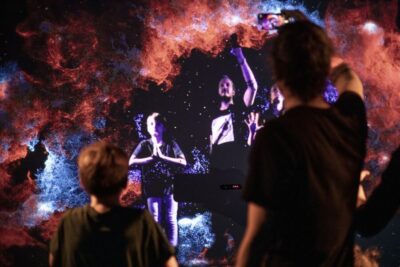
Prague’s past comes alive through film, audio, and mixed reality at Story of Prague Museum. You move from knights and kings to the Hussites, the Golem, Nazi occupation, Soviet rule, and the Velvet Revolution without facing a row of dusty cases and long labels.
I like the broad timeline, which helps you connect medieval Prague with the city’s modern struggles. I also like the museum’s unusual touches, including a hidden room and displays that do not appear in the usual promotional images. The main drawback is that the QR codes may feel overused, especially if you try to scan everything.
Key points
- Three floors cover Prague from medieval legends to modern freedom.
- Mixed reality, film installations, and audio put you near the action.
- The Golem, medieval torture displays, and a hidden room add theatrical flair.
- The second floor handles Nazi occupation, wartime bombing, and Soviet rule.
- A 90-minute visit fits well into a busy Prague sightseeing day.
- The $19.27 admission is strongest for visitors who enjoy interactive museums.
A fast, theatrical introduction to Prague
Story of Prague Museum takes a different path from a traditional city museum. Instead of asking you to study long texts in silence, it uses sound, moving images, digital features, and staged displays to give each period a sense of place.
That approach matters in Prague, where the past can feel layered and confusing. Medieval religious conflict, royal power, Nazi rule, communism, and the peaceful Velvet Revolution all belong to the same city. The museum puts those periods into one clear route.
You should expect a visit of about 1 hour and 30 minutes. That is long enough to cover the major themes without taking half a day from Prague Castle, the Old Town, or the riverfront.
The atmosphere is part of the design. The halls are dimly lit, which suits the museum’s legends and darker chapters. You will also find an enormous figure of the Golem, the legendary clay figure linked with Jewish folklore in Prague.
This is not a quiet collection built mainly for art specialists. It is aimed at people who want a quick, accessible introduction to Prague’s story, with enough visual drama to keep younger visitors and museum skeptics interested.
More museums and galleries in Prague:
- Prague: Museum of Fantastic Illusions Entry Ticket
★ 4.3 · 4,337 reviews - IAM Illusion Art Museum Entry Ticket
★ 4.2 · 1,664 reviews - Prague: Museum of Senses Admission Ticket
★ 4.0 · 1,445 reviews
Floor one: kings, Hussites, and the Golem
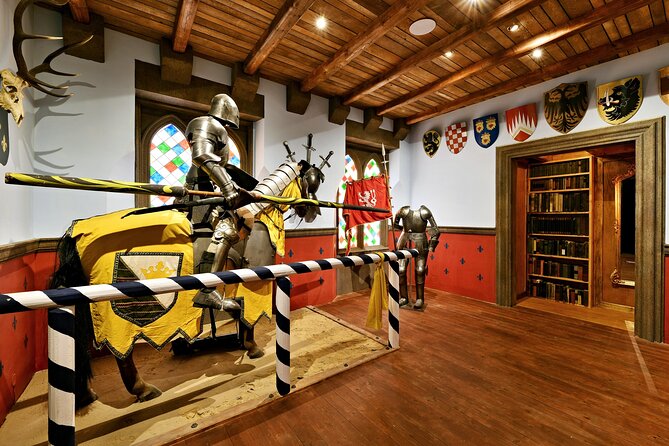
The first floor takes you into medieval Prague. You encounter knights and kings, the world of Jan Žižka, the Hussites, medieval torture, and the construction of the Old Town Hall and Astronomical Clock.
Jan Žižka and the Hussites are especially useful subjects for a first visit to Prague. The Hussite movement grew from religious reform and social unrest in the early 15th century. Žižka became one of its best-known military leaders. You do not need a detailed background in Czech history to follow the basic story, and the museum’s visual presentation helps explain why this period still matters.
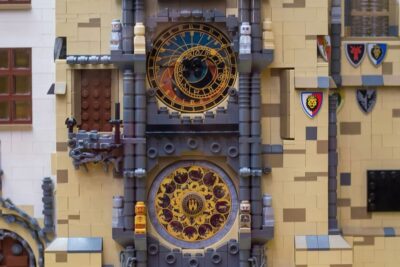
The Old Town Hall and Astronomical Clock provide a familiar anchor. You may already have seen the clock’s hourly show in the Old Town Square, but learning about its construction gives the landmark more weight. The museum connects a popular sight with the people, technology, and civic ambition behind it.
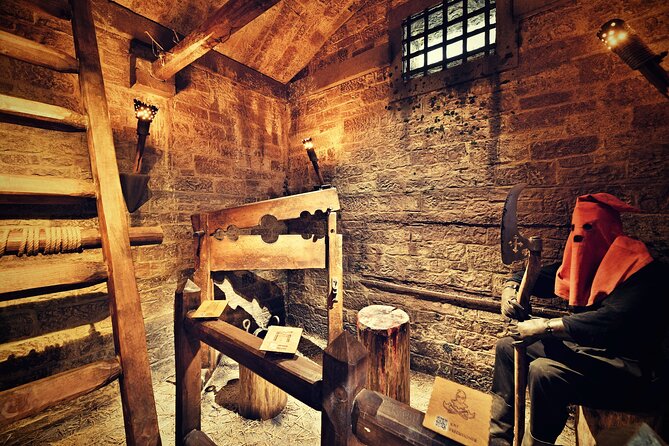
The medieval torture section is presented without practical demonstrations. That distinction matters if you are deciding whether to bring children or if you prefer history without graphic reenactments. The subject is still grim, but the museum treats it as part of the period’s legal and social world rather than as a cheap scare attraction.
Then comes the Golem. In the low light, the tall figure gives the room a strong dose of folklore. The Golem is tied to stories of Rabbi Judah Loew and the Jewish community of Prague, though the museum’s treatment is best understood as a dramatic introduction to the legend rather than a full study of Prague’s Jewish history.
You may find the first floor the most theatrical part of the visit. It mixes objects with atmosphere, so you are not just reading about the past. The tradeoff is that digital extras can begin to crowd the experience. QR codes appear throughout the museum, and scanning every one could slow you down.
My advice is simple: scan only the codes that genuinely interest you. You do not need to treat every phone prompt as an assignment.
Floor two: occupation, bombing, and Soviet rule
The second floor shifts from medieval legend to the painful modern era. It covers the Nazi occupation, the bombing of Prague, and the Soviet occupation.
This change in tone is important. The museum does not present Prague only as a pretty city of towers, bridges, and old squares. It reminds you that the city endured occupation, political control, war, and fear during the 20th century.
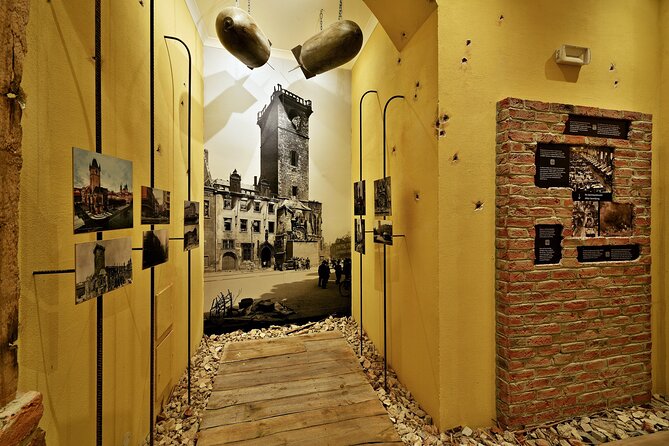
The Nazi occupation section introduces a period when daily life was shaped by outside rule and violence. The bombing material adds another layer by showing that Prague’s built environment was not untouched by war. Many visitors know the city for its preserved historic center, so it is useful to remember that preservation does not mean the city escaped the upheavals of the century.
The Soviet occupation section brings the story forward again. Here the museum deals with the political reality that followed the Second World War. For visitors from outside Central Europe, this part can help explain why Czech attitudes toward Soviet power, state control, and political independence remain important.
You should not expect a full academic account of either occupation in 90 minutes. The museum gives you a framework, key images, and emotional signposts. If you want detailed military history, political analysis, or a full account of Czech Jewish history, you will need other museums and historic sites as well.
Still, the second floor helps prevent a common mistake: treating Prague as a city frozen in the Middle Ages. Its recent past is just as important as its castles and clocks.
The visual style also changes the way you absorb difficult material. Film installations and audio elements can make events feel more immediate than a printed panel. That can be effective, though some people may prefer a quieter presentation with more documents and fewer effects.
Floor three: the Velvet Revolution and Czech achievement
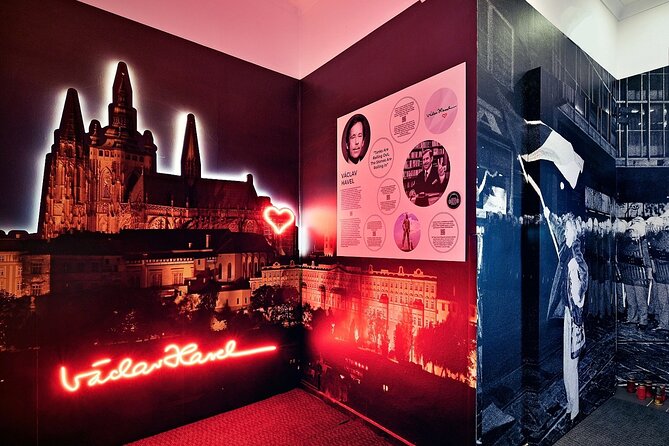
The third floor turns toward the Velvet Revolution and Czech accomplishments around the world. This gives the visit a hopeful final movement after the darker middle section.
The Velvet Revolution of 1989 ended four decades of communist rule in Czechoslovakia through largely peaceful public protest and political change. It is one of the most important modern events in Prague, and placing it near the end of the museum gives the overall route a clear shape: royal power, religious conflict, occupation, dictatorship, and finally renewed civic freedom.
This part may connect especially well with what you see around Prague. Public squares, memorials, and historic buildings are not just scenic backdrops. They have been used for demonstrations, speeches, political control, and public celebration. The museum gives you a little context before you walk back into those spaces.
The section on Czech global achievements broadens the focus beyond wars and governments. It suggests that the country’s story also includes creativity, invention, and international influence. The supplied information does not list every achievement or exhibit, so I would treat this as a short closing survey rather than a full national showcase.
That balance is welcome. The museum is not only about suffering and political change. It also wants you to leave with a sense of Czech contribution and identity.
Same city, a completely different afternoon:
- Prague: 50-Minute Sightseeing Evening Cruise
★ 4.2 · 33,780 reviews - Prague: Medieval Dinner with Unlimited Drinks
★ 4.4 · 19,847 reviews - Prague: Skip-the-line Castle Ticket and Optional AudioGuide
★ 4.3 · 11,121 reviews - Prague: Castle Tour with Local Guide and Entry Ticket
★ 4.6 · 10,422 reviews
Why the interactive design works, and where it can tire you
The museum’s main strength is variety. Film, audio, physical displays, mixed reality, and digital codes give you several ways to take in the material.
For many people, this is easier than reading long museum panels. You can watch a scene, listen to an explanation, then look at a physical exhibit. The changing format is useful if your attention fades after several traditional museums.
Mixed reality also helps the museum place you near an event instead of simply naming it. The exact technology and content can vary by display, but the goal is clear: blend authentic stories with digital presentation so the city’s past feels active.
There is a limit, though. Interactive museums can sometimes ask too much from your phone. QR codes are a good example. They can add extra material for anyone who wants it, but scanning every code may turn a relaxed visit into a checklist.
I recommend choosing a few. Use the codes when a display catches your attention or when you want more background. Ignore the rest and keep moving. You will get more from the museum if you control the pace.
The hidden room adds a small sense of discovery. Since its exact contents are not fully detailed, I would not build your expectations around a major secret chamber. Think of it as an extra reward for looking carefully.
The museum also includes exhibits that do not appear in photographs. That matters because online images often reveal the most dramatic objects before you arrive. Here, some of the interest comes from seeing displays in person and discovering how they fit into the route.
Is $19.27 good value for 90 minutes?
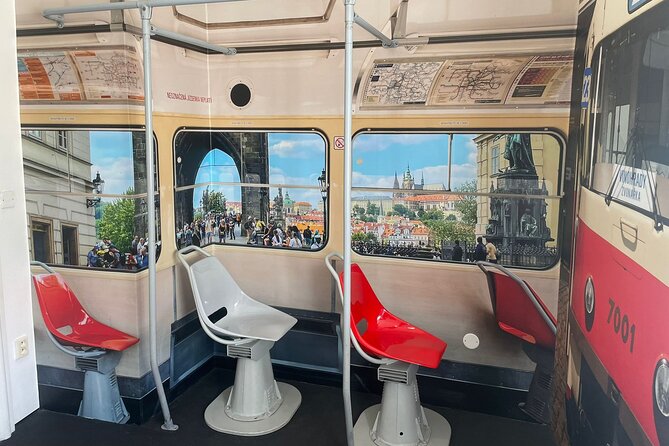
At $19.27 per person, this is not the cheapest museum visit in Prague. The value depends on how you like to learn.
If you want a quick, broad introduction to Prague, the price is reasonable. You get a chronological route, several major eras, and a presentation designed to hold your attention. The 90-minute length also makes it easy to fit between other activities.
The price is less attractive if you want a large collection of original objects, detailed scholarship, or a specialist museum focused on one subject. Story of Prague is a presentation-driven experience. You are paying for the combination of storytelling, technology, atmosphere, and admission, not just for the number of artifacts.
I would see it as a useful first stop rather than the final word on Prague’s past. Visit early in your stay, then use what you learn to make more sense of the Old Town Hall, Astronomical Clock, historic squares, and modern memorials.
The average booking time is 12 days ahead, which suggests you may want to reserve before your visit, particularly if your schedule is fixed. Confirmation arrives at booking, and the ticket is mobile, so you do not need to arrange a paper voucher.
The listed start time is 10:00 a.m. A morning visit can give you a clear historical frame for the rest of the day. You are also near public transportation, which makes the museum practical to reach as part of a larger sightseeing plan.
Who will enjoy this museum most?
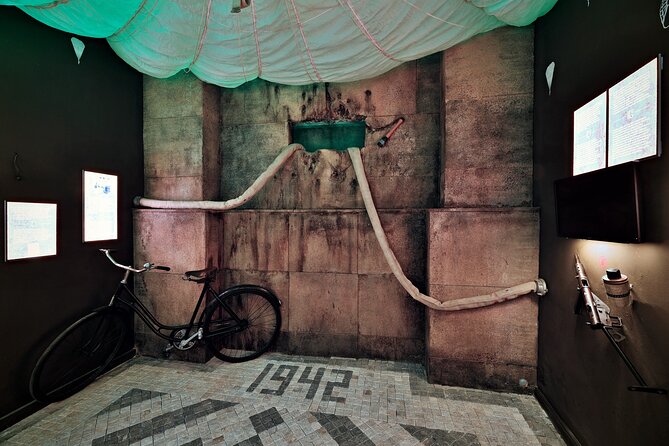
I would recommend Story of Prague to first-time visitors who want the main historical outline without committing to a long guided tour. It should also suit families and mixed-age groups because the displays use more than text.
It is a good match for anyone who likes film, sound, digital displays, and dramatic presentation. The Golem and medieval material may appeal to children, while the Nazi, Soviet, and Velvet Revolution sections give adults more serious context.
The museum may be less satisfying for visitors who prefer quiet galleries, original documents, or long periods of close study. It is also not enough on its own if your main interest is one narrow topic, such as Jewish Prague, the Hussite wars, or communist Czechoslovakia.
Most people can participate, and the attraction is near public transportation. No special guide names are provided, and this is an admission visit rather than a named guide-led walk, so you should expect to follow the museum’s own presentation at your pace.
Free cancellation is available if you cancel at least 24 hours before the start time. A cancellation made inside that window is not refunded, and changes are not accepted during the final 24 hours. Those rules are worth noting if your Prague plans are still uncertain.
My booking advice
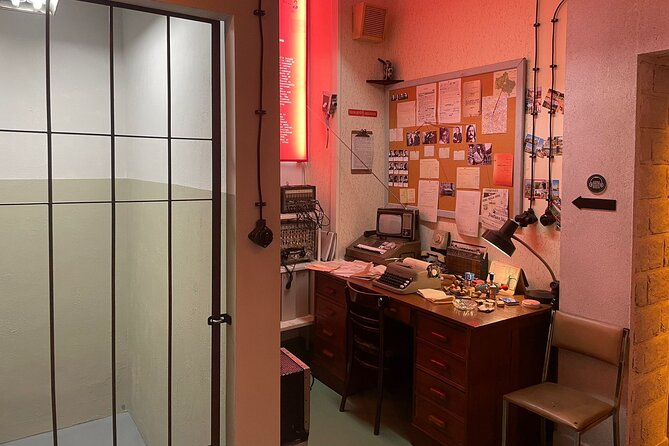
Book Story of Prague Museum if you want a lively 90-minute introduction that connects the city’s famous medieval sights with its difficult 20th-century past. The Golem, mixed reality, hidden room, and film installations give the visit more personality than a standard timeline display.
Skip it if you want a major collection of original artifacts or a specialist history museum. At $19.27, the experience earns its price through presentation and range, not through exhaustive detail.
For most first-time visitors, I would place it early in a Prague itinerary, ideally at the 10:00 a.m. start. You will leave with a better sense of the city’s long story, and you can then see its streets and landmarks with more context.
FAQ
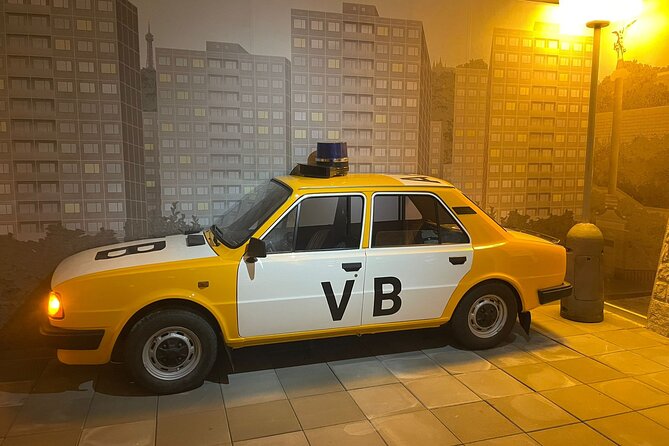
Where is Story of Prague Museum located?
It is located in Prague, Czech Republic. The museum is near public transportation.
How long does the museum visit take?
The visit lasts approximately 1 hour and 30 minutes.
What time does the experience start?
The listed start time is 10:00 a.m.
How much does admission cost?
The listed price is $19.27 per person.
What historical periods does the museum cover?
The museum covers medieval Prague, including knights, kings, Jan Žižka, the Hussites, medieval torture, the Old Town Hall, and the Astronomical Clock. It also covers the Nazi occupation, the bombing of Prague, the Soviet occupation, the Velvet Revolution, and Czech achievements.
Does admission include entry to the museum?
Yes. Admission to Story of Prague Museum is included.
Is the ticket available on a mobile device?
Yes. The experience features a mobile ticket.
Can I cancel for a full refund?
Yes, if you cancel at least 24 hours before the experience start time. Cancellations made less than 24 hours ahead are not refunded, and changes inside that period are not accepted.
Just added around Prague
- WWII and Communism History in Prague’s Old Town Private Tour★ 5.0 · 4 reviews
- World War II 4WD Tour from Prague with Lunch★ 4.4 · 3 reviews
- Prague: Historical Walking Tour with Focus on World War 2★ 4.3 · 12 reviews
- Unique salt cave in Prague★ 4.9 · 10 reviews
- Walking tour of Prague in French : Nové Město★ 4.9 · 16 reviews
- Walking tour of Prague in french: Old Town & Charles Bridge★ 4.9 · 62 reviews
- Prague: Market Tour and Traditional Czech Cooking Class★ 4.7 · 19 reviews
- Ultimate Unlimited Beer Pong with Czech Beer★ 4.6 · 5 reviews
Museums, compared.


IAM Illusion Art Museum Prague Fast Pass Ticket
Read our review →
Ticket to Audiovisual Light Art at Lumia Gallery
Read our review →
Browse the lists this tour appears in